An enterprise AI agent platform is software a company uses to build, run and govern AI agents that act on its own systems. An AI agent here means software that uses a language model to choose its next step and then carries it out through tools, such as reading a record or filing a request. The options range from business-user builders inside Microsoft 365 or Salesforce to cloud runtimes for developers and managed teams that do the building for you.
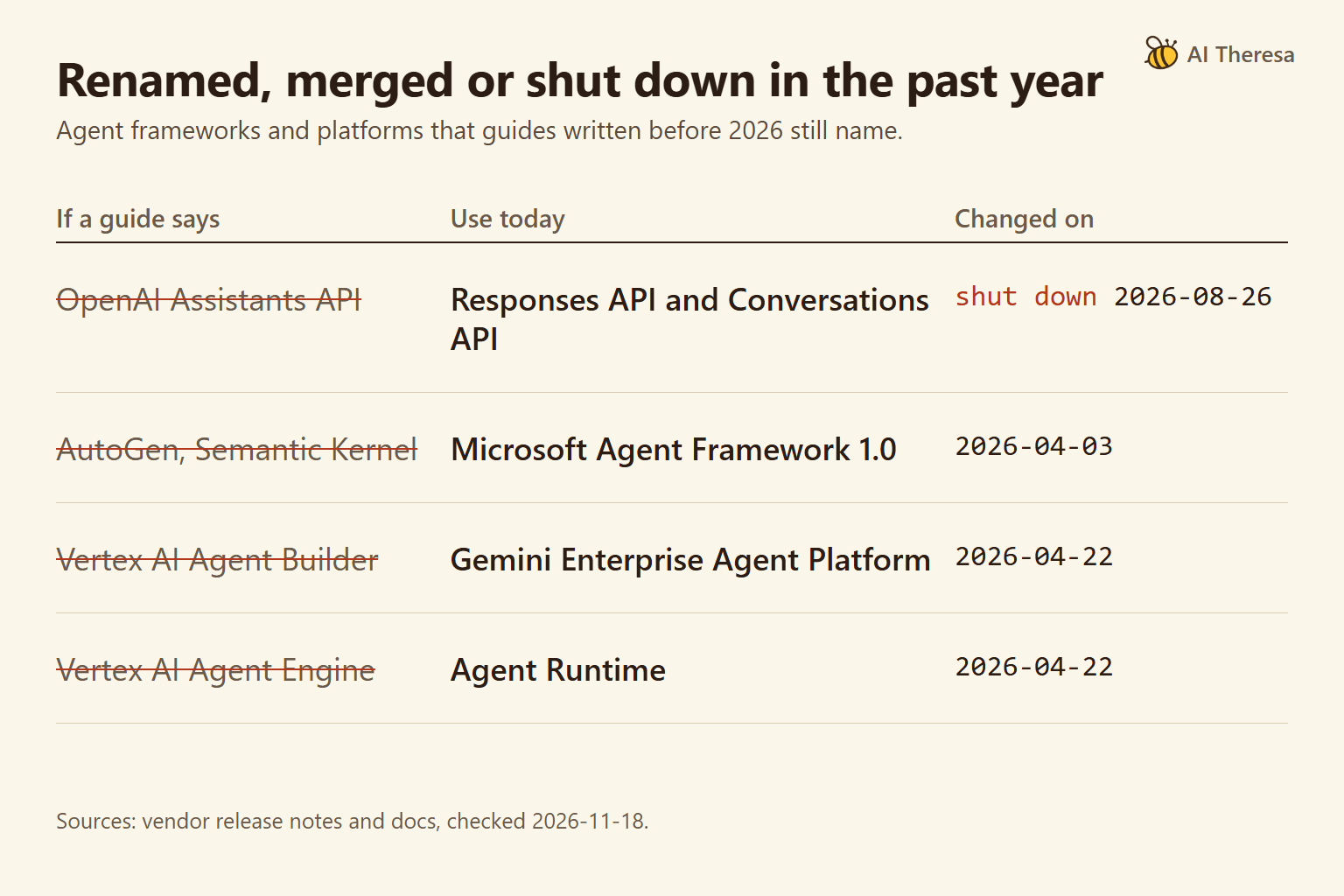
A platform matters when a task needs judgment between steps and touches systems with real permissions. A fixed sequence, such as copying form data into a CRM, fits an ordinary workflow tool at lower cost. The choice is also a bet on a vendor's roadmap: OpenAI's Agent Builder is scheduled to shut down on November 30, 2026, a little over a year after its launch.
Below we rank seven platforms against criteria stated up front. AI Theresa, one of the seven, is our company; it sits at #2, and its entry says where it falls short.
What Are Enterprise AI Agent Platforms?
An enterprise AI agent platform supplies what an agent needs to work inside a company: a way to build it, a place to run it and controls over what it does. The build part ranges from a visual designer for business users to a software development kit (SDK), a code library developers use to write the agent. The run part keeps the agent's progress, calls its tools and retries failed steps. The govern part records who the agent acts as, what it may touch, what it did and what it spent.
Vendors use the word "agent" loosely. Anthropic's distinction between workflows and agents is a useful test. Workflows follow "predefined code paths," while agents "dynamically direct their own processes and tool usage." Many products sold as agent platforms mostly run workflows, which is fine when the steps are known in advance.
Analysts now treat governance as its own category. In October 2026 Gartner published its first Magic Quadrant for AI agent management platforms. Gartner defines these as platforms that manage agents "independent of the execution environment." A large company may build agents on one platform and govern them from another.
Gartner predicted in June 2025 that over 40% of agentic AI projects will be canceled by the end of 2027, citing escalating costs, unclear business value and inadequate risk controls. That is a forecast, not a measurement. A platform can cap spend and enforce permissions, but it cannot tell you whether a workflow is worth automating.
In the same release, Gartner estimated that only about 130 of the thousands of vendors selling agentic AI offer real agents, and called the rest "agent washing." Apply Anthropic's test to every product on a shortlist.
Get Started with Theresa for FREEHow Do Enterprise AI Agent Platforms Work?
Build, connect and run
Most platforms offer two ways to build. Business users describe an agent's role and tools in a visual designer, as in Copilot Studio or ServiceNow's AI Agent Studio. Developers write the agent in code with an SDK or an open framework. They then deploy it to a managed runtime such as Amazon Bedrock AgentCore, which accepts agents built with LangChain, the OpenAI Agents SDK or other frameworks.
Agents reach company data and other agents through connectors and two open protocols. The Model Context Protocol (MCP) is "an open-source standard for connecting AI applications to external systems." The Agent2Agent (A2A) protocol lets agents from different vendors pass work to each other, so MCP links an agent to tools and data while A2A links it to other agents.
The runtime is the service that executes the agent and keeps its state, meaning the record of what it has already done. An agent that waits days for an approval needs that record. Google says its Agent Runtime supports agents "that maintain state for days at a time," and AgentCore Instances keep sessions for up to 14 days.
Govern, observe and stop
Each agent needs an identity of its own, so that logs show which agent did what. Microsoft gives supported hosted Foundry agents their own Entra Agent ID, and Google's platform includes Agent Identity, Agent Registry and Agent Gateway. Permissions then limit which tools and records each agent may use.
Teams also need a way to stop an agent and cap its spend. ServiceNow has renamed AI Control Tower to Super Intelligence Control Tower. In May, ServiceNow said the product can detect an agent that "operates beyond its permissions" and "shut it down in real time."
Microsoft announced organization-level cost policies for Copilot Studio at Ignite in November 2026.
One request through the layers
The following is an illustration of what a copyright-risk agent needs from a platform, not a description of the copyright-risk agent Theresa's team built for a media group (see entry #2). A new upload matches a title the company monitors, and that match triggers the agent. The agent pulls the rights record through a connector, calls a matching service and scores the risk. A takedown request changes something outside the company, so the platform routes it to a person for approval and writes the decision to an audit log.
Production adds failure paths. If the matching service times out, the runtime retries the step. Microsoft's Foundry Agent Service notes warn that "recovery reruns the handler, so developers should save progress and prevent duplicate side effects." Here that means the agent must never file the same takedown twice.
If the agent lacks permission to file in a region, the case should wait in a queue for a person instead of failing silently.
Our guide to enterprise AI agent deployment goes deeper on rollout.
Get Started with Theresa for FREE7 Best Enterprise AI Agent Platforms
We ranked the seven on five criteria: (1) who gets an agent into production on your real systems, (2) identity, permissions, audit and a way to stop an agent, (3) where agents and data run, including your own cloud account or servers, (4) reach through MCP, A2A or third-party agents, and (5) pricing you can forecast.
We weighted the first criterion most heavily, because in our experience pilots more often stall on connecting real systems than on platform features. A different weighting changes the order: if your customer work already lives in Salesforce, Agentforce belongs near the top.
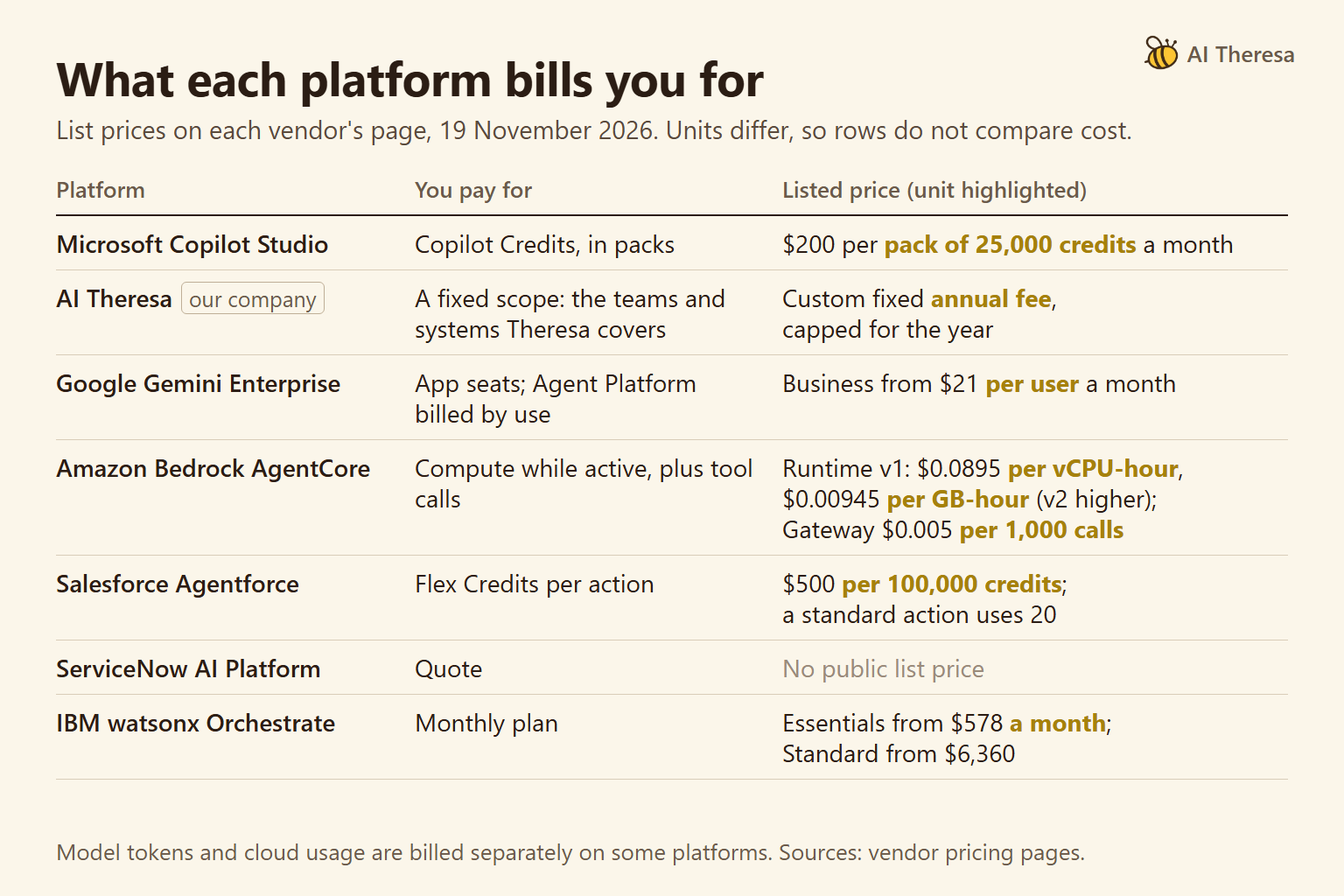
Prices are as listed on each vendor's page on November 19, 2026, and their units differ.
1. Microsoft Copilot Studio and Microsoft Foundry Agent Service
Microsoft sells its agent stack in three parts. Copilot Studio is the builder for business users, and Microsoft Foundry Agent Service is the runtime for developers. Agent 365 is the governance layer, which Microsoft calls "a control plane" for identity, security and management. The stack fits companies that already run on Microsoft 365 and Entra ID.
Agent identities in Entra, announced cost policies and tools for both business users and developers make it strong on governance and reach. The limits are overlap between three products and credit billing that is hard to forecast before a pilot. Deployment of Foundry agents to customer-owned Azure Kubernetes Service clusters is still "coming soon," with a preview targeted for early December.
It ranks first because both business users and developers can reach production on the data most companies already hold in Microsoft 365. For most buyers, that self-serve reach outweighs the done-for-you delivery of the team at #2. It trails on where agents run until customer-owned clusters ship.
Copilot Studio pricing lists a capacity pack at $200 a month for 25,000 Copilot Credits. An Azure subscription is required to use agents.
2. AI Theresa
AI Theresa is an AI forward-deployed engineering team, not a builder you operate yourselves. A forward-deployed engineer (FDE) works inside a customer's business to turn a problem into a running system. Theresa's team takes one business problem from diagnosis to a running AI system. It deploys that system in the customer's own cloud on AWS, Google Cloud or Azure, with on-premises as an add-on.
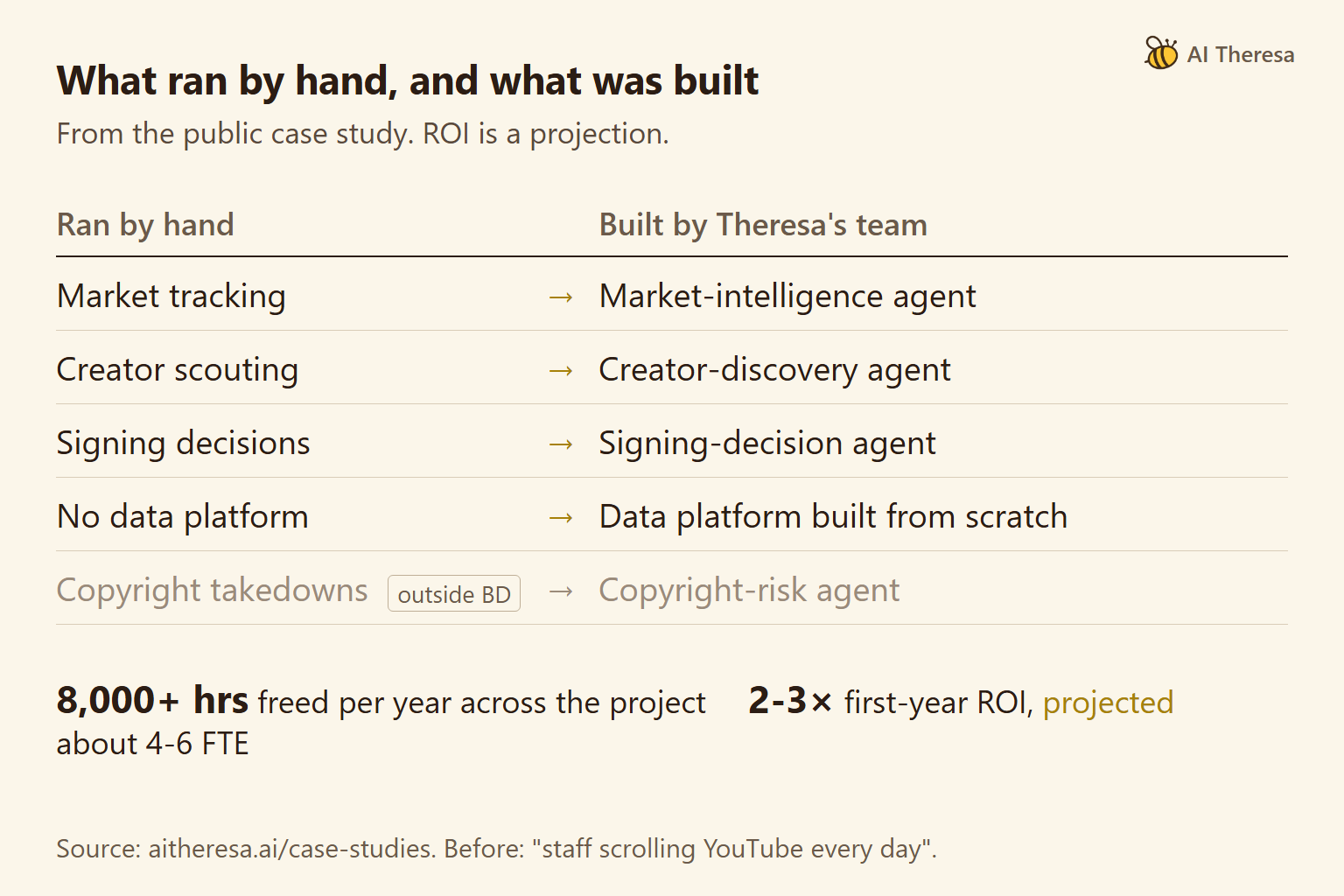
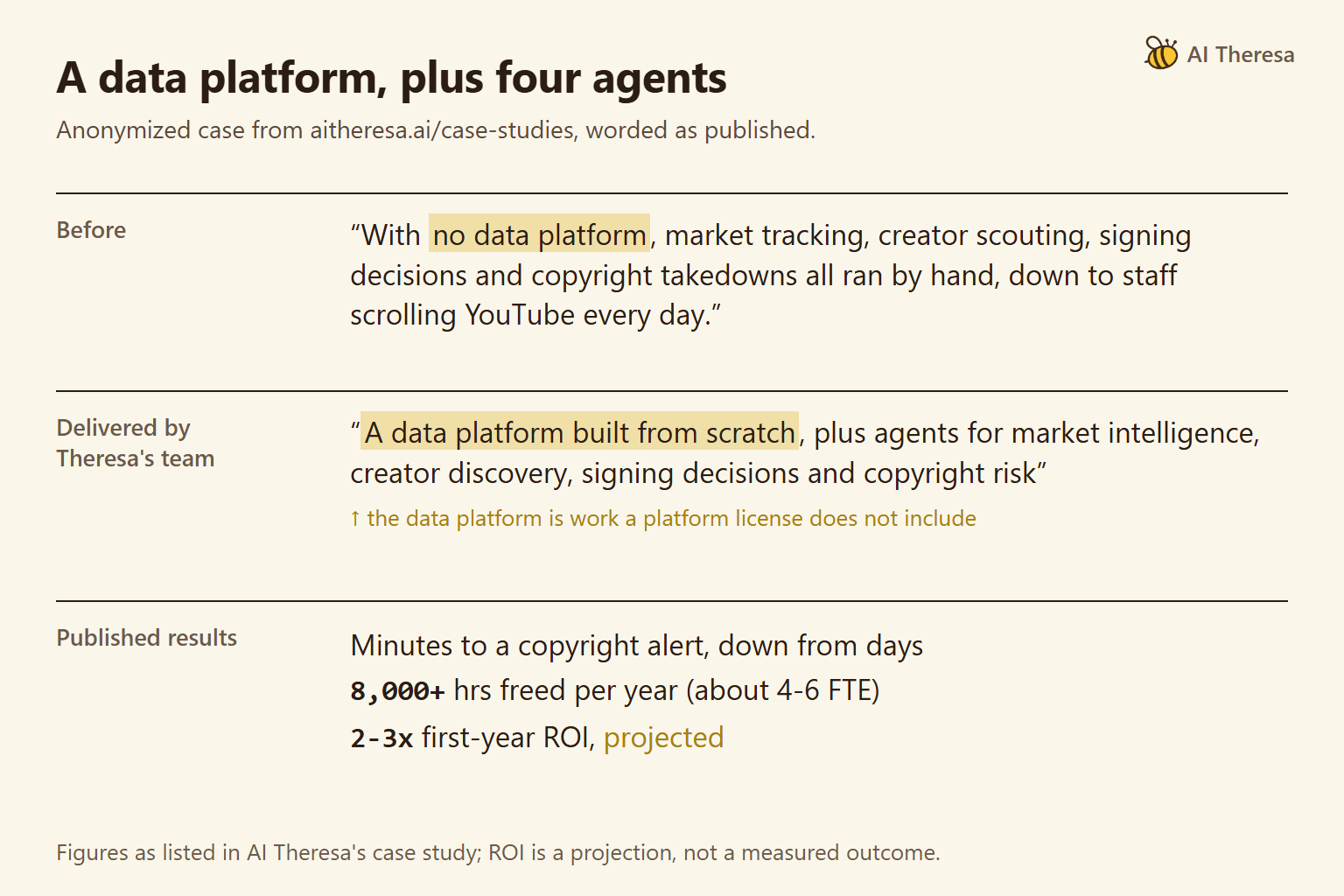
That puts it high on getting to production and on where systems run. In one published case, a film and TV media group's international division had no data platform. Its copyright takedowns, among other work, "all ran by hand, down to staff scrolling YouTube every day."
Theresa's team built a data platform from scratch, plus agents for market intelligence, creator discovery, signing decisions and copyright risk. The published case lists minutes to a copyright alert, down from days; 8,000+ hours freed per year (about 4-6 FTE); and a 2-3x projected first-year ROI.
There is no visual builder or SDK for your own staff, and no published price: the Enterprise plan is a custom fixed annual fee. Once quoted, that fee is easy to forecast, since it is fixed and capped for the year. We are a younger vendor with no analyst coverage, and the model fits one prioritized problem better than a company-wide builder rollout. Governance depends on what the team builds in your cloud, so ask to see the permission and approval design during the 14-day free trial.
The closest comparable is OpenAI Frontier, which pairs a platform with OpenAI's own FDEs. It launched in February 2026 for "a limited set of customers," and OpenAI has not published its pricing.
3. Google Gemini Enterprise and Gemini Enterprise Agent Platform
Google sells two products here. Gemini Enterprise is the app employees use. Gemini Enterprise Agent Platform, which Google calls "the evolution of Vertex AI," is where developers build and run agents. The pair fits companies on Google Workspace or Google Cloud that want agents across several vendors' tools.
Long-running agents with saved state, identity and gateway controls, and third-party agents in the higher app editions are what it does well. The catch is that these are separate purchases. Google's FAQ says the Agent Platform is not included with the app and uses pay-as-you-go billing.
The Gemini Enterprise Business edition starts at $21 per user a month for teams of up to 300. Standard and Plus prices come from Google's sales team, and both tiers offer 30-day trials.
It ranks below Theresa because your own staff do the production work, in Google Cloud rather than your own account.
4. Amazon Bedrock AgentCore
AgentCore is the AWS service for running agents that developers write in any framework. It fits engineering teams that want to own the agent code.
The default runtime is serverless. AgentCore Instances instead run agents on AWS-managed EC2 instances "in your own account," with sessions of up to 14 days. Your team builds the agent and its business logic, and there is no designer for business users. It ranks below Google because your own developers must build everything above the runtime.
AgentCore pricing bills the original Runtime at $0.0895 per vCPU-hour and $0.00945 per GB-hour; the newer Runtime v2 is $0.1276 per vCPU-hour and $0.0169 per GB-hour on consumption pricing. Gateway costs $0.005 per 1,000 calls. Model tokens are billed separately. Our comparison of cloud infrastructure for AI agents goes deeper.
5. Salesforce Agentforce
Agentforce builds agents on Salesforce data and workflows. It fits companies whose customer records, cases and sales pipeline already live in Salesforce. At Dreamforce 2026, Salesforce announced long-horizon agents with general availability planned for November 2026, plus orchestration of third-party agents over A2A.
Agents act directly on the CRM records they need. Most of the value sits on Salesforce data, though, and billing mixes credits, conversations and per-user licenses. Its reach and price forecasting weaken outside Salesforce, so it ranks fifth.
The Agentforce pricing page lists Flex Credits at $500 per 100,000 credits, and a standard action uses 20 credits. By our arithmetic, that is $0.10 per action at list price. Unmetered Agentforce add-ons for Sales, Service and Field Service cost $125 per user a month; a metered Agentforce User License is $5 per user a month plus Flex Credits.
6. ServiceNow AI Platform
ServiceNow's AI Agents run inside the IT, HR and customer service workflows the platform already manages. Admins define an agent's role in natural language, and its tools are the flow actions, subflows and scripts the customer already has.
Super Intelligence Control Tower is the reason to shortlist it, since ServiceNow says it can stop an agent that goes beyond its permissions. Outside ServiceNow-managed work, its reach drops. There is no public list price, so pricing comes through a quote. It ranks sixth for the same reach limit as Salesforce.
7. IBM watsonx Orchestrate
watsonx Orchestrate is IBM's platform for building agents and coordinating them across business applications. It fits companies that already use IBM software or that must keep data on their own servers.
On-premises deployment is the reason to pick it. IBM says Orchestrate runs as a managed service "on IBM Cloud, AWS or in your own on-premises environment," and its Premium tier adds data isolation.
IBM reports that Gartner named it a Leader in the new AI agent management Magic Quadrant; Microsoft reports the same placement, and trade press lists ServiceNow as the third Leader. The limits are a fit weighted toward IBM-aligned companies and high prices for the upper tiers. It ranks seventh because fewer buyers need on-premises control, and your own staff still do the production work.
watsonx Orchestrate pricing starts at $578 a month for Essentials and $6,360 a month for Standard, with a 30-day trial. IBM calls these prices "indicative."
The seven at a glance
| Rank and platform | Best fit if your work lives in | Who builds and runs the agent | Where it can run | How you are billed |
|---|---|---|---|---|
| 1. Microsoft Copilot Studio and Foundry | Microsoft 365 and Azure | Business users or your developers | Microsoft cloud; customer-owned clusters coming | Copilot Credits and Azure usage |
| 2. AI Theresa | One costly problem across several systems | Theresa's team: a product lead and two engineers | Your AWS, Google Cloud or Azure account; on-premises add-on | Fixed annual fee |
| 3. Google Gemini Enterprise | Google Workspace and Google Cloud | Business users (app) or your developers | Google Cloud | Seats plus platform usage |
| 4. Amazon Bedrock AgentCore | AWS | Your developers | AWS-managed runtime, or your own AWS account (Instances) | Compute time and calls |
| 5. Salesforce Agentforce | Salesforce CRM | Salesforce admins and developers | Salesforce | Credits, conversations or add-ons |
| 6. ServiceNow AI Platform | ServiceNow IT, HR and service | ServiceNow admins | ServiceNow | Quote |
| 7. IBM watsonx Orchestrate | IBM software or on-premises needs | Business users and developers | IBM Cloud, AWS or on-premises | Monthly plan |
How to Choose an Enterprise AI Agent Platform
1. Start with one workflow that has a measurable cost
Gartner's advice is to pursue agentic AI only "where it delivers clear value or ROI." Anthropic goes further and suggests "finding the simplest solution possible," which "might mean not building agentic systems at all." Pick one workflow where you can count hours, delays or errors today, and write that number down before the pilot starts.
If you do not know which workflow costs most, measure before you buy. Observation, a free desktop app from AI Theresa, ranks a team's highest-cost workflows. It helps pick the first workflow but does not build or run agents.
2. Decide who will build and run the agent
Take the copyright agent. On AgentCore or Foundry, your developers write it and its retry logic. In Copilot Studio or Agentforce, an admin configures it, but the rights database must already be reachable by a connector. With an outside forward-deployed team such as AI Theresa or OpenAI Frontier's FDEs, that team builds the connector and the agent.
Our FDE-as-a-service guide explains that model.
Then count the work that comes before any agent. In the media group's case, there was no data platform to connect, and an agent needs data to read. That project was broader than the one-workflow pilot recommended above; its first deliverable was data that all four workflows needed. Ask who will connect source systems, write evaluations (tests that check an agent's output against known answers) and watch the agent after launch.
3. Ask where every piece runs and how you stop it
Ask each vendor where the model, the runtime, your data and the logs sit. Ask who the agent acts as, which writes need a person's approval, how an admin stops a running agent and what happens when spend hits a cap. In the copyright example, the agent should pause when its budget runs out instead of retrying.
4. Test failure paths and plan the exit
In the pilot, force the failures on purpose. Time out a tool, revoke a permission and replay a step. Check that the runtime retries without duplicate writes and that blocked cases land with a person. Run it at peak volume too, such as a full day of uploads replayed in an hour, and record cost per case and queue length.
Then plan the exit. OpenAI is closing Agent Builder on November 30, 2026, and recommends the Agents SDK or Workspace Agents in ChatGPT for workflows that should continue. Keep prompts, tool definitions and evaluation sets in files you own, so they can move with you.
Get Started with Theresa for FREEConclusion
Choosing among enterprise AI agent platforms comes down to three questions: where your work already lives, who will build and run the agent, and where the agent and its data must run.
Pick one workflow with a measured cost and pilot it on the two platforms that best fit those answers. Commit company-wide only after the pilot passes cost, permission and retry tests, and after you have exported the agent's definitions once.