Using AI in business development means handing research, list building, drafting and record-keeping to AI tools or agents, while people keep the relationships and the decisions. The tools range from a chat assistant that drafts a meeting brief to an agent that ranks prospects overnight. Many now run inside the CRM, the customer relationship management system where your team logs accounts and deals.
AI pays off when your team spends many hours a week on repeatable research and admin. It matters less if you close a few large deals a year that depend on long personal relationships. This article returns to one real case: the international division of a film and TV media group, where Theresa's team built agents for creator discovery and signing decisions.
What Is AI-Powered Business Development?
AI-powered business development is the use of AI software to find, research and qualify partners, markets and deals, with a person making each commitment. Business development, or BD, decides which partners, markets and large deals a company pursues. Sales then closes volume inside those choices, so BD work is slower and heavier on research.
The help ranges from a chat assistant answering one request to an agent that picks its own next step. In between sits a workflow that runs fixed steps, "predefined code paths" in Anthropic's distinction between workflows and agents. Our guide to agentic workflow automation covers how these work. For a BD lead, the question is which tasks are predictable enough to hand over.
Get Started with Theresa for FREEHow AI Is Transforming Business Development
McKinsey's state of AI in 2026 survey, published in August, found that 37% of respondents attribute at least some EBIT impact to AI. EBIT, or earnings before interest and taxes, is a plain measure of operating profit. That share was about the same as the year before. The high performers in the survey "fundamentally redesign workflows" around AI instead of adding it to existing ones.
Sales teams report a similar pattern. Salesforce's State of Sales 2026 report is a vendor survey of 4,050 sales professionals. Sellers there expected agents to cut prospect research and email drafting time by about a third, but those are expectations, not measured results.
Vendors now build prospecting agents into the CRM itself. Salesforce describes a Prospecting Agent on its sales product release page that researches accounts overnight and returns a ranked list. HubSpot documents a prospecting agent that drafts outreach for contacts a rep enrolls. Both start from your CRM records, and Salesforce's also pulls web and third-party data.
In the same Salesforce report, over half of sales leaders using AI say disconnected systems slow their AI projects. A Salesforce executive warned there that agents without the full customer picture produce "garbage outputs." For BD, that picture includes partner notes, event conversations and market data that often sit in inboxes and spreadsheets outside the CRM, so check where yours live before buying an in-CRM agent.
Get Started with Theresa for FREEHow to Use AI for Business Development
For each job below, a person still owns one check. Start with the one that costs your team the most hours, then add the next.
1. Research accounts and partners before the first call
An AI assistant can read a partner's website, recent press and your CRM notes, then draft a one-page brief before a meeting. A rep no longer spends an hour opening tabs before each call. The risk is invented detail. OpenAI defines hallucinations as "plausible but false statements," and its research on why models hallucinate traces them to training that rewards guessing.
Ask for a source link next to every fact in the brief. The person taking the meeting opens the link for anything they plan to mention.
2. Build partner and prospect lists from your own criteria
An agent can scan public sources and your CRM, then rank accounts or partners against criteria you write down. Salesforce says its Prospecting Agent returns "a ranked hit-list" with a "why now" reason for each account.
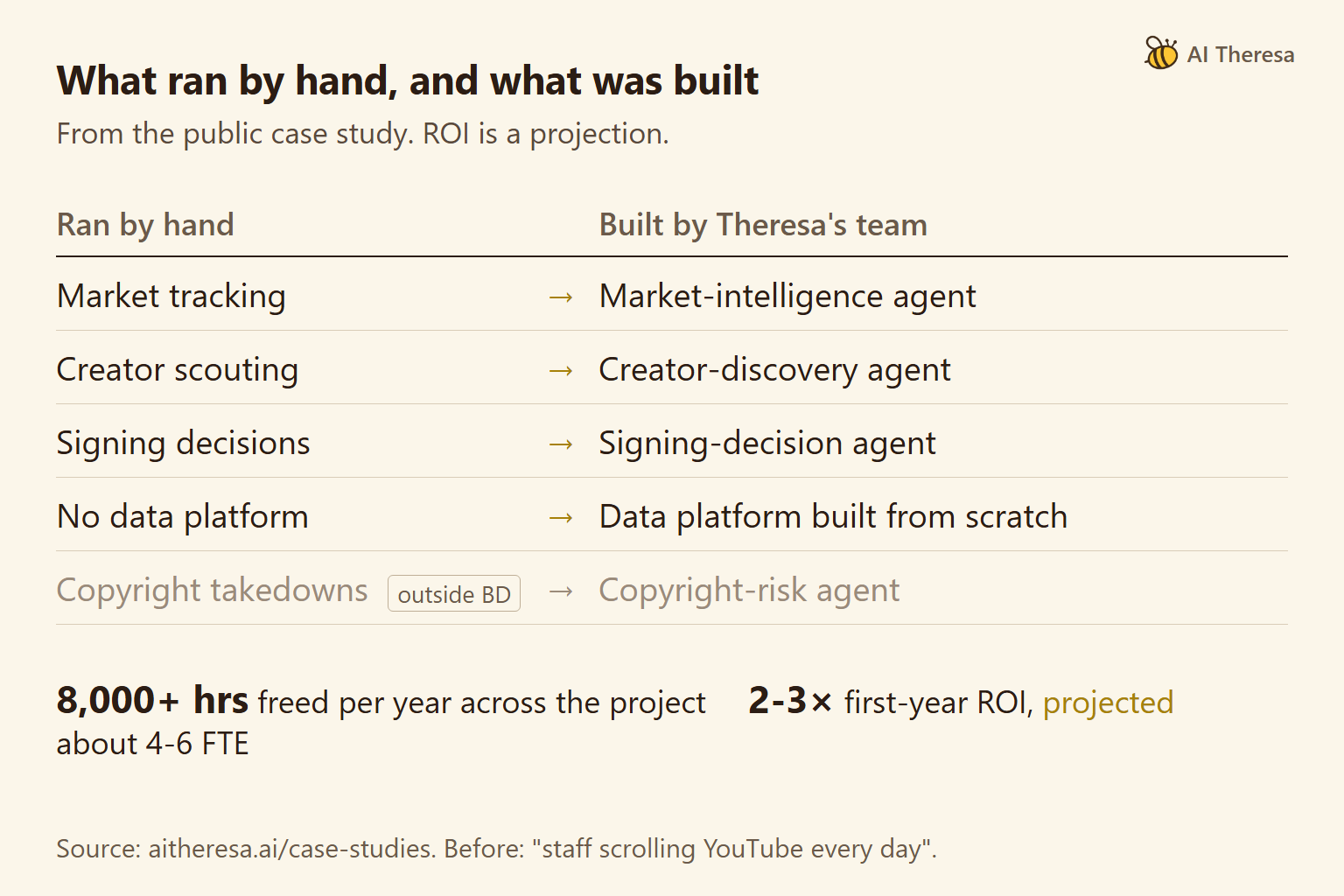
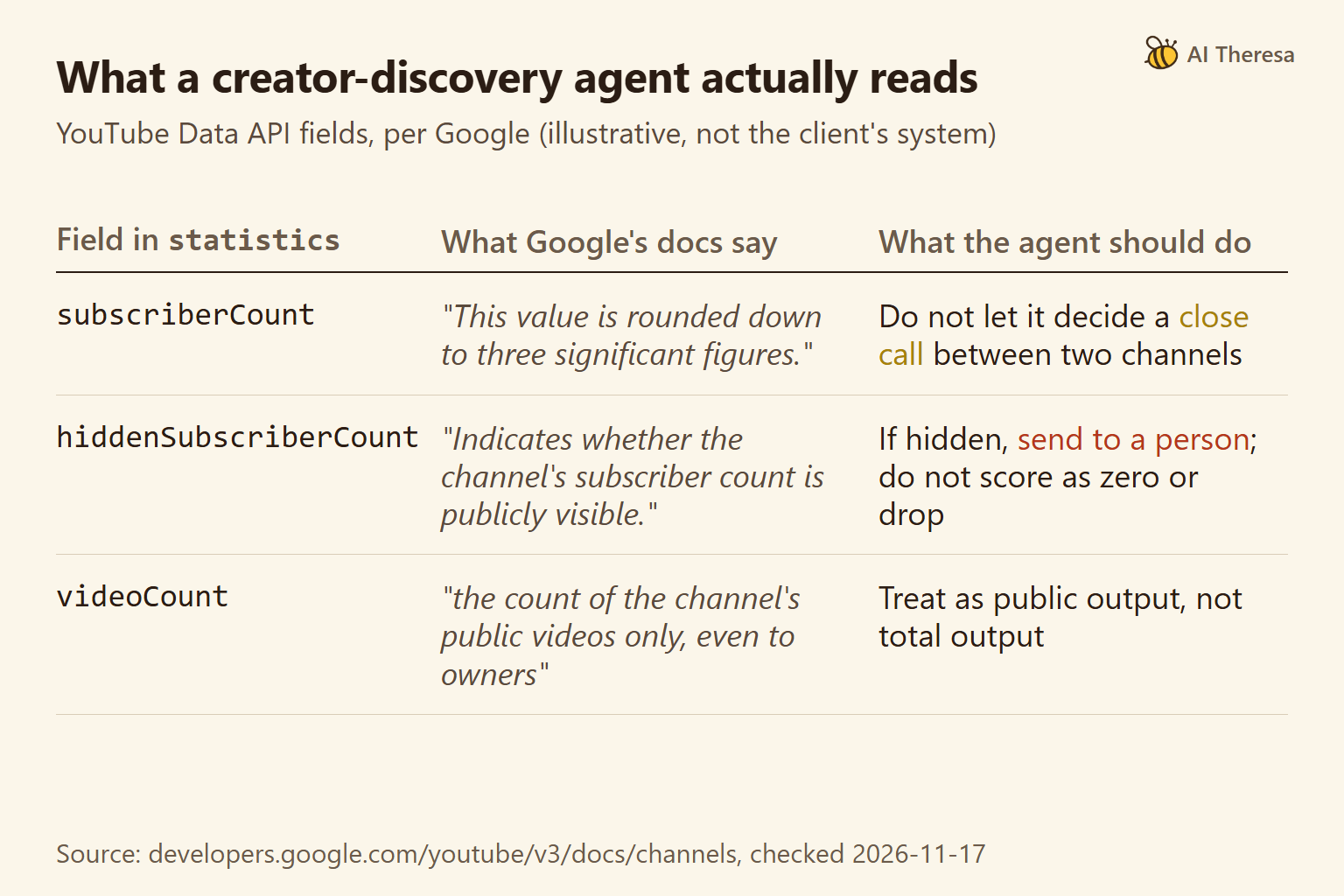
At the media group, the case study says market tracking, creator scouting and signing decisions all ran by hand, "down to staff scrolling YouTube every day." Theresa's team built a creator-discovery agent for that work. In an illustrative version built from YouTube's public documentation (not the client's system), the agent reads the YouTube Data API, the official interface programs use to read channel data. Google documents its subscriber counts as rounded down to three significant figures or hidden by the owner, and its video counts as public videos only.
A channel with a hidden count should go to a person instead of scoring zero. Public data shows reach, not audience: viewer geography and watch time come from the creator's own analytics, which YouTube releases only to authorized requests, so ask for them before a signing call.
3. Rank the partners and deals you already have by recent activity
For BD the useful ranking is often your own pipeline: which partners and open deals have gone quiet. In a creator-signing team, that is the creator who stopped replying three weeks ago while their channel kept growing. HubSpot's prospecting agent, for example, considers engagements "up to the past year," such as form submissions, page views, calls, meetings and notes, when it picks contacts and writes outreach.
Activity nobody logged does not count. A partner who talks to your CEO at events but never fills in a form can rank near the bottom. Have a rep spot-check the top ten and bottom ten each week, and fix the logging gaps they find.
4. Draft outreach, and let a person send it
AI drafts a good first message when it has the brief from way 1. The FTC's CAN-SPAM compliance guide says the US law "makes no exception for business-to-business email," so commercial emails to companies need an opt-out and a postal address too.
In the UK, the ICO's guidance on email marketing says sole traders and some partnerships "are treated as individuals." The ICO notes that this guidance is under review after the Data (Use and Access) Act. Independent creators often trade as sole traders, so a cold marketing email to one needs their prior consent. The soft opt-in rarely helps here, because it covers only people who bought or negotiated to buy similar products from you.
LinkedIn's User Agreement bans bots that "send or redirect messages." A person checks that the contact may be emailed, reviews the draft and sends it from their own account.
5. Capture meetings and keep the CRM current
Meeting-capture tools record calls, write summaries and fill CRM fields such as next steps and competitor mentions. Tell partners at the start that the call is recorded and summarised, and turn it off if they object. A summary that nobody reads can still record a wrong next step as fact.
The deal owner skims each summary within a day and corrects it before it becomes the record. Colleagues will rely on that record when the deal changes hands.
6. Watch competitors and the market
An agent can check competitor sites, release notes, job posts and video channels on a schedule, then send an alert when something changes. For a media company, the alert that matters is a rival network announcing a creator in a market you are scouting, with a link to the announcement.
Each month, have the owner count how many alerts led to an action; if almost none did, cut sources until they do. Your team reads the source before acting on anything that affects a deal or a price.
7. Draft proposals, decks and deal briefs
Drafting carries the least risk of the eight, because a person reads every page before it leaves the company. AI can turn call notes into a proposal outline, a first deck or a deal brief for leadership. Its usual weakness is confident filler, such as product claims nobody approved.
Pricing, terms and delivery dates come from a person, never from the draft. Keep a small library of approved paragraphs about your offer, and have the AI quote from it instead of writing new promises.
8. Prepare go/no-go decisions, then decide yourself
A go/no-go decision is the yes or no on a signing, a market or a bid. An agent can assemble the evidence pack, with a source for each point. In an illustrative creator-signing pack, that is the channel's public statistics, the audience data the creator shared after the way 2 request, past emails with your team, and any rights conflicts. The pack says "unknown" wherever the creator has not shared analytics.
The BD lead reads it, signs or passes, and records the reason. Where the criteria are written down and stable, a fixed checklist workflow is often enough; an agent earns its place when it has to decide which source to check next.
Get Started with Theresa for FREEHow to Build an AI-Powered Business Development Strategy
An AI strategy for BD is a short list of the workflows you will change first, the data each needs and the person who checks each output.
1. Find the workflow that costs the most hours
Start from your team's hours, not from a vendor demo. Ask each person to log a normal week, or measure it with software. The workflow with the most repeated hours and the clearest output is your first candidate.
Theresa's Observation is a free desktop app that ranks a team's costliest workflows from the Slack, Zoom, Gmail, Docs, Calendar and browser work people approve. It does not score leads, write outreach or pick a tool, and it is currently invite-only.
2. Fix the data the agent will read
An agent reads your CRM, spreadsheets and shared drives as they are. If partner notes live in personal inboxes, the agent cannot see them. Pick one place where account and partner records live before you automate anything on top of it.
The media group's project included a data platform built from scratch, alongside the agents. Most BD teams need a smaller version of that step, such as one clean partner list with an owner for each row.
3. Start simple, and decide whether to buy or build
Anthropic recommends "finding the simplest solution possible, and only increasing complexity when needed." Often that is a prompt and a shared spreadsheet rather than an agent. Buy an off-the-shelf tool when your job matches what it was built for, such as email sequences. Build when the data and the decision are specific to your business.
Building means someone owns the agent's data, prompts and fixes after launch. That can be your own team or an outside one. At the media group, Theresa's team built the agents and the data platform under them, and Theresa's Enterprise plan runs systems like these in your own cloud for a fixed annual fee.
4. Budget for usage and set the checkpoints
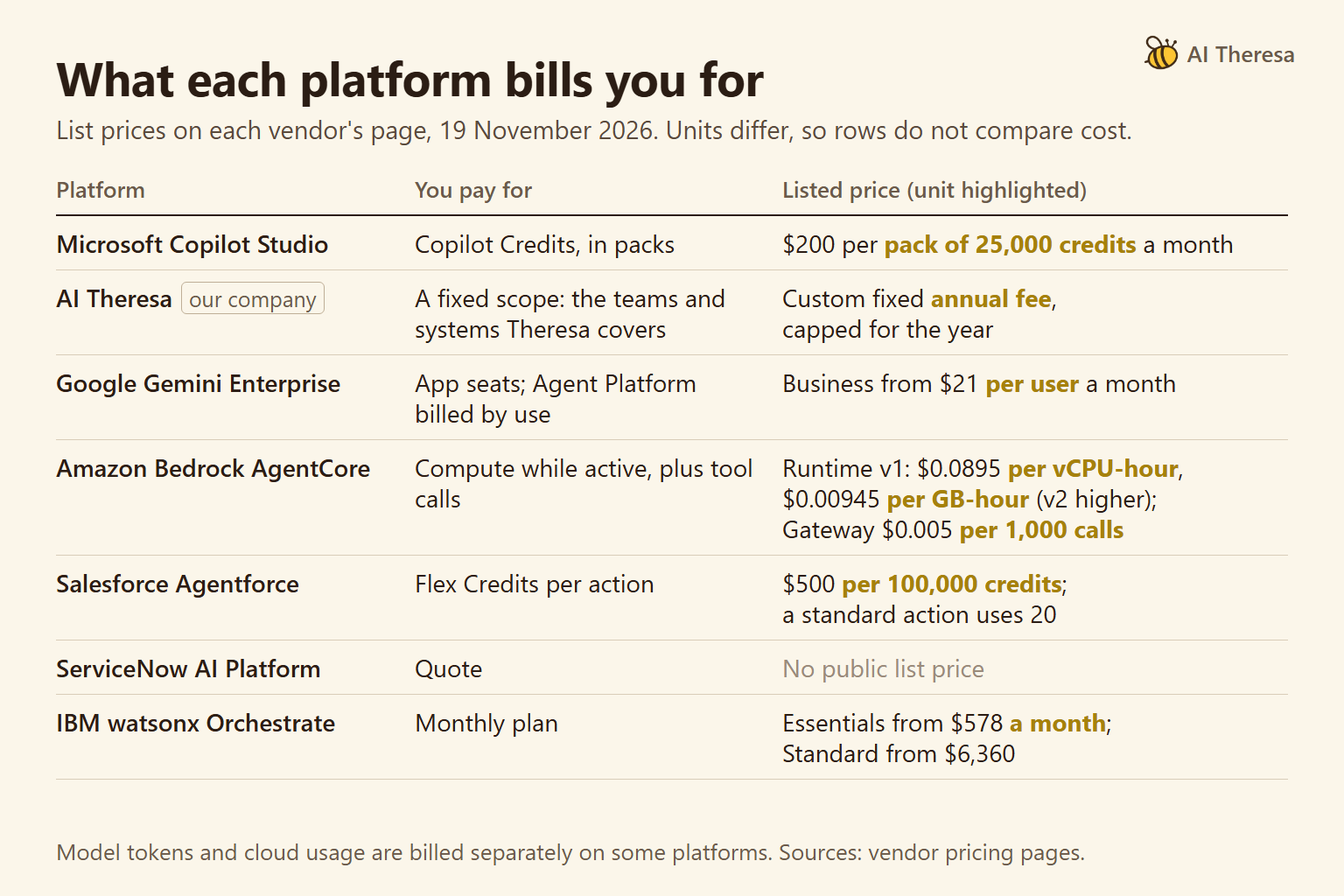
Many agents are priced by use. HubSpot's prospecting agent spends HubSpot Credits for each lead it writes personalized outreach for, and Clay prices its plans by actions and data credits. In McKinsey's survey, about a fifth of respondents say AI operating costs limited their use.
Write down each checkpoint: who reviews which output, and what a wrong output looks like. Our guide to enterprise AI agent deployment covers the evidence to collect before you expand a pilot.
Get Started with Theresa for FREEHow AI Helps Identify New Business Opportunities
New opportunities often hide in volume: thousands of channels, companies or listings that no team can read every week. AI can read that volume on a schedule and surface the few worth a person's time.
First, pick the sources where your next partner shows up before anyone calls you. For a media company that is video platforms; for a software vendor it may be app marketplaces, funding news or job posts that name a technology. Use official APIs or data you are licensed to use, so the feed does not break when a site changes its layout.
Second, write the threshold down before the agent runs, such as a minimum audience size, a growth rate or a market you serve. Then check the misses: each month, have a person read a sample of what the agent rejected. If good candidates sit in that sample, the threshold is too strict or a field is missing.
Third, review what gets surfaced in a fixed slot each week, with one owner. Each candidate arrives with its source links and one line on why it passed. The owner marks it pursue, park or drop, and that record becomes the test of whether the agent finds anything you would not have found.
Figure 2 shows what a discovery agent reads from YouTube's public data, and where it should hand off to a person.
Benefits of Using AI in Business Development
Each benefit below comes with a number to track and a question that number cannot answer.
| Benefit | What to measure | What it does not tell you |
|---|---|---|
| Less research time | Hours per brief or list, before and after | Whether the freed hours went to selling |
| Wider market coverage | Partners, accounts or channels reviewed per week | Whether the extra candidates are any good |
| Cleaner CRM records | Deals with a current next step and owner | Whether the summaries are accurate |
| Faster go/no-go decisions | Days from first contact to a decision | Whether the decisions were right |
McKinsey's 2026 survey shows the gap between what teams measure and what that number does not tell them. In it, 80% of respondents said AI improved their individual productivity, while far fewer saw any effect on operating profit. The hours count only if you can show where they went, such as more partner meetings booked.
The case study reports more than 8,000 hours freed per year across the project, copyright work included, about four to six full-time staff. The case study does not say how many of those hours went to new signings, which is the column-three question. The case study's 2-3x first-year return on investment is a projection, so treat it as a forecast until the year is over.
Get Started with Theresa for FREEConclusion
Using AI in business development works best as a change to one workflow at a time. Pick the BD job that costs your team the most hours, let AI do the gathering and drafting, and keep people on relationships and commitments.
Use one rule to decide what to hand over. Automate a step only when you can name the person who checks its output and describe what a wrong output looks like. If you cannot name either, keep that step with your team for now.