A reporting pipeline can run successfully while the finance team still spends every Monday reconciling its output. An AI assistant can produce convincing answers while lacking access to the records employees actually need. These problems cross the boundary between software implementation and how a business works.
FDE as a Service puts engineers alongside the people dealing with those problems. They learn how the work gets done, build a solution in the customer's systems, and stay involved through deployment and handover.
The arrangement can help when a project keeps getting passed between teams because no one owns the whole process. But hiring an external team only works if the business can give it access, answer questions, and make decisions. Here's how the model works and what to look for in a provider.
Quick takeaway: FDE as a Service brings in engineers to take a business problem from investigation to working software. A good engagement also leaves your team with the code, documentation, and knowledge to keep it running.
What Is FDE as a Service?
FDE stands for forward-deployed engineering, or forward-deployed engineer when referring to a person. An FDE works closely with a customer's users and technical teams to turn an operational problem into functioning software. The work can involve data, application code, integrations, infrastructure, and AI.
Palantir's forward-deployed software engineer role illustrates the approach: engineers work directly with customers, investigate their problems, and build production software. Independent service providers adapt that approach to different teams and projects, so the responsibilities vary.
The “as a Service” version supplies this capacity through an external agreement. Providers may offer a scoped project, an embedded team, or ongoing support. For example, Entrans describes an FDE service covering discovery, implementation, deployment, and continued iteration. Confirm the responsibilities in the actual proposal rather than relying on the label.
An embedded engineer needs regular access to users and technical teams, though they may work remotely. For example, someone fixing a finance report needs to speak with the person who reconciles it, not just read a ticket. AI development tools may help with implementation; engineers still own the design and review.
Get Started with Theresa for FREEHow Does FDE as a Service Work?
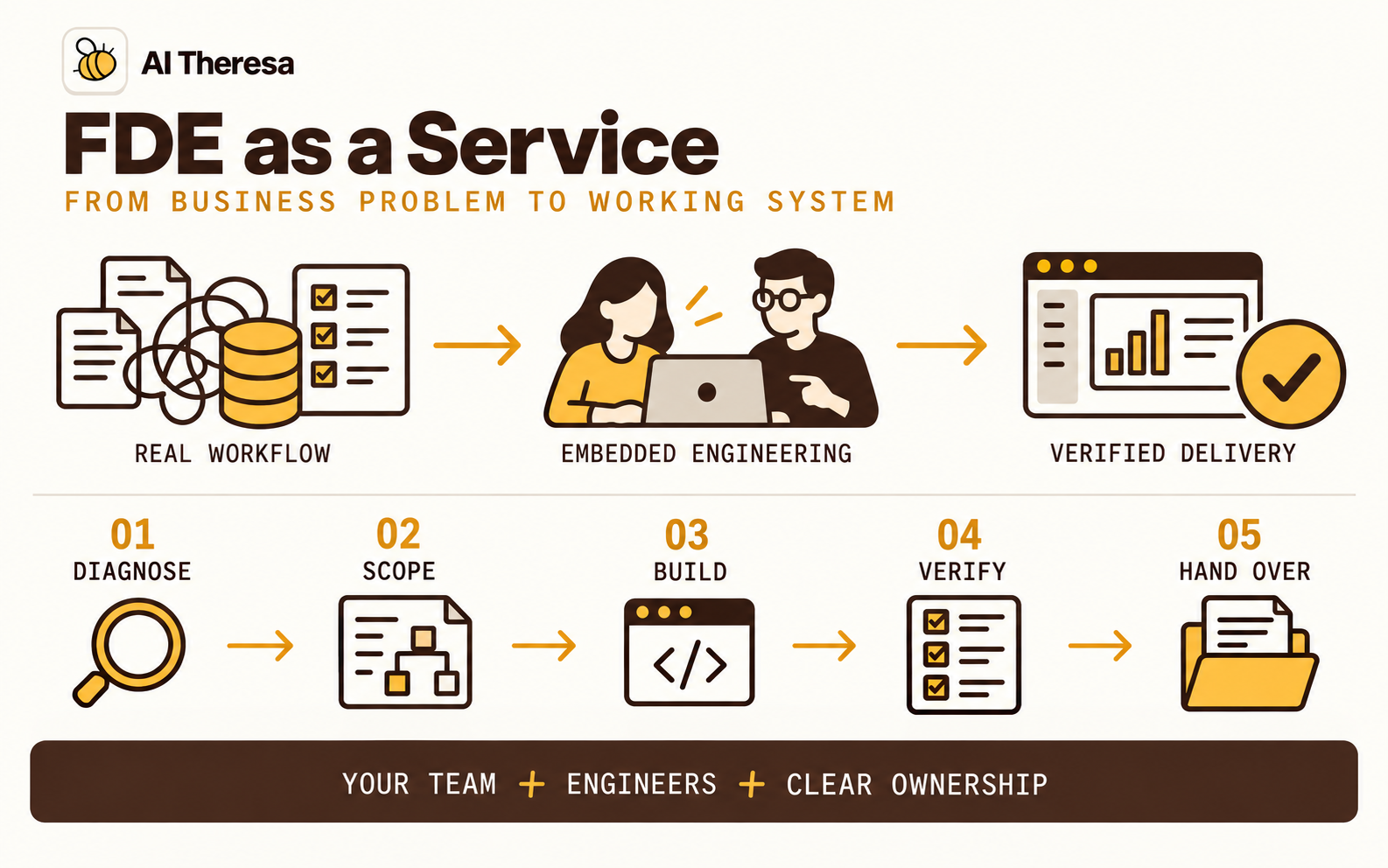
The details vary by provider, but an engagement usually needs to answer five questions: What is going wrong? What will we fix? How will we build it? Does it work? Who takes care of it afterward?
1. Diagnose the actual workflow
Engineers speak with users, inspect approved technical context, and follow the work across systems. They distinguish the visible symptom from its cause. For inconsistent reporting, that might mean tracing metric definitions, late events, and manual spreadsheet adjustments.
Establish a baseline before changing anything: time spent, failure frequency, processing cost, or another measure connected to the problem.
2. Agree on scope and acceptance
Write down what completion means and who signs it off. “Improve reporting” is vague. “Produce the weekly report from approved sources, reconcile specified totals, and flag incomplete inputs” gives both teams something they can test.
Agree on access, deployment authority, exclusions, and how additional discoveries affect the schedule and budget.
3. Build inside the existing environment
The team builds the pipeline, interface, integration, or automation the project needs. Put early versions in front of users with realistic data. A finance analyst may spot a missing adjustment rule in minutes that would otherwise survive weeks of development.
Work should follow the customer's review and release process, with an agreed path for testing changes outside production.
4. Verify and release
Check correctness, permissions, failure behavior, and usability. Compare the result with the baseline. A report should distinguish missing inputs from genuine zero values; an integration should show whether an external update actually completed.
Release with monitoring and a recovery plan appropriate to the change.
5. Hand over or continue support
Deliver source code, deployment instructions, configuration references, and an operational runbook. Identify who handles incidents and future changes. If the provider remains involved, define support coverage and response expectations separately from the initial delivery milestone.
Get Started with Theresa for FREEFDE as a Service vs Traditional Data Engineering
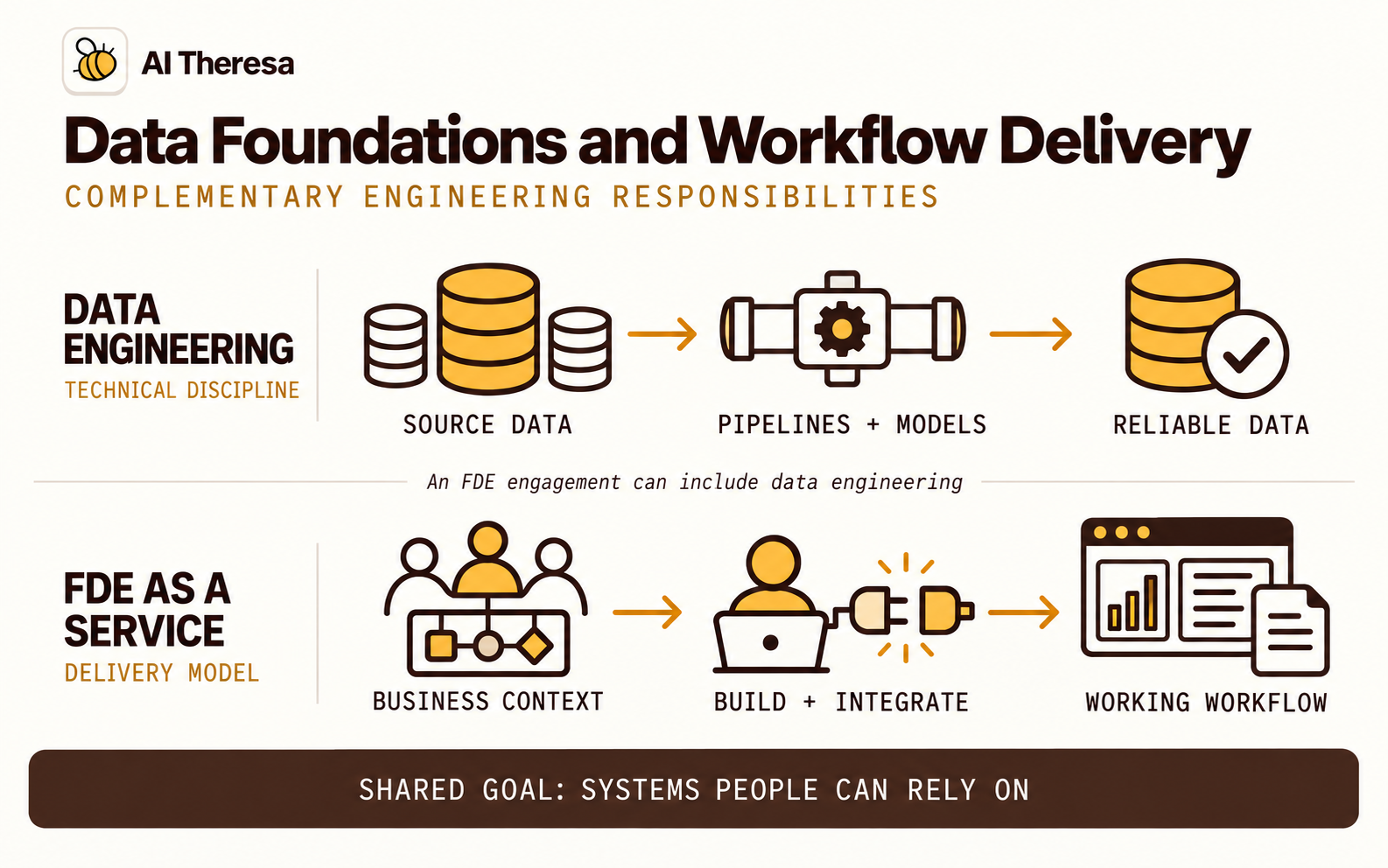
These categories describe different things. Data engineering is a technical discipline; FDE as a Service is a delivery model. A forward-deployed engagement may include substantial data engineering, and an internal data engineer may work directly with business users.
Microsoft's data engineer role outline includes ingesting and transforming data, managing analytics solutions, and monitoring and optimizing them. Those foundations remain necessary when an FDE builds a workflow on top of them.
| Dimension | Traditional data engineering focus | FDE as a Service focus |
|---|---|---|
| Starting point | Data requirements and platform needs | A customer workflow or operational problem |
| Common deliverables | Pipelines, data models, reliable datasets, and monitoring | An implemented solution that may combine data, applications, and integrations |
| Scope | Often centered on the data lifecycle | Can cross technical and organizational boundaries |
| Working relationship | Internal team or contracted data specialists | Embedded collaboration under a service agreement |
| Acceptance | Correctness, freshness, reliability, and efficient processing | Technical acceptance plus an agreed workflow outcome |
| Continuing ownership | Usually follows the data team's remit | Must be defined through handover or support terms |
There is plenty of overlap between these roles. Maintaining a shared data platform calls for sustained data-engineering capacity. Getting a stalled onboarding process working across three applications may call for an engineer who can follow the problem across all three, including the steps people perform manually.
Key Benefits of FDE as a Service
Shorter feedback loops
Direct contact with users helps engineers catch misunderstandings early. A prototype may reveal that a missing approval step matters more than a new dashboard. Finding that out in the first week is much cheaper than discovering it after the dashboard has shipped.
Access to relevant engineering capacity
A project may need database expertise for one phase and application development for another. A provider can supply that mix without the customer hiring each specialty immediately. Ask who will actually be assigned; the experience of those engineers matters more than the size of the firm's roster.
Continuity from diagnosis to deployment
When the same engineers investigate and implement a fix, users have fewer people to bring up to speed. The person who heard why a report was wrong can check whether the finished version answers the original question.
Knowledge transferred through delivery
Architecture notes, code reviews, runbooks, and paired work can help the customer's team maintain the result. Treat that transfer as a deliverable. Faster initial implementation has limited value if every later adjustment requires starting discovery again.
To judge whether the arrangement pays off, compare the result with the original problem. Include the hours your own staff spend answering questions, reviewing changes, and learning to maintain the software.
Get Started with Theresa for FREEFDE as a Service Use Cases
Here are four examples of projects that can suit this approach.
Repairing unreliable reporting
A business receives conflicting numbers from its warehouse and operational tools. An FDE can trace source events, reconcile definitions, fix transformations, and update the reporting workflow. Acceptance could require consistent totals for a defined historical period and clear handling of late data.
Bringing an AI pilot into production
A support assistant needs approved knowledge sources, user permissions, reliable retrieval, and an escalation path. The engagement can connect those pieces and evaluate answers against representative questions. Success should include useful, supported responses and appropriate handling of questions the system cannot answer.
Connecting fragmented operational tools
An onboarding process spans a CRM, a ticketing system, and internal records. Engineers can map the handoffs and connect the systems. If creating an account succeeds but assigning a support ticket fails, staff need to see that partial result and know which step to retry.
Diagnosing production cost or reliability problems
A team sees rising infrastructure spend or recurring failures that cross service boundaries. An embedded engineer can trace the cause and test a fix. Comparing similar workloads before and after the change helps separate an actual improvement from a quiet week of traffic.
AI Theresa takes this diagnosis-and-delivery approach to existing production systems, including unreliable pipelines, incorrect metrics, and infrastructure costs. Its published process covers approved access, investigation, fixes, and retaining company context for later work. As with any engagement, the proposal should name the people doing the work and explain what support continues after delivery.
Get Started with Theresa for FREEFDE as a Service: Challenges and Limitations
A small project can keep growing
Discovery often uncovers adjacent problems. Without priorities, a small workflow project can become a platform migration. Record new findings separately and decide which changes are necessary for the agreed outcome.
Progress depends on the customer's time
Engineers need appropriate access and timely answers from process owners. An external team cannot settle conflicting business definitions by itself. Assign a customer lead who can resolve requirements and coordinate decisions.
A working demo can be hard to maintain
A working demonstration may hide brittle assumptions about schemas, credentials, or third-party behavior. Review how changes are tested, how failures become visible, and how the customer can operate the system after the provider leaves.
The business still has decisions to make
The business still owns its priorities, access decisions, and acceptance criteria. AI-assisted implementation adds a need to review generated code and validate outputs. Purchasing engineering capacity does not transfer every operational decision to the vendor.
The bill extends beyond engineering hours
Include discovery, delivery, infrastructure, software licenses, support, and internal staff time. Compare those costs with the value of the problem solved. An ongoing, well-understood workload may justify an internal team rather than repeated external engagements.
Get Started with Theresa for FREEHow to Choose an FDE as a Service Provider
Ask about work that resembles your problem. A provider that knows your database may still be unfamiliar with your approval process or release restrictions. Look for examples of how the assigned engineers dealt with comparable constraints, including what went wrong and how they handled it.
Use the proposal to resolve the following questions:
| What to ask | What a useful answer includes |
|---|---|
| Who will do the work? | Named leads, relevant experience, availability, and backup coverage |
| How will scope be defined? | A bounded outcome, dependencies, exclusions, and a change process |
| How will access be handled? | Approved accounts, required permissions, credential handling, and offboarding |
| What proves completion? | Acceptance criteria, test evidence, user review, and baseline comparison |
| What will we receive? | Source code, configuration documentation, deployment instructions, and runbooks |
| Who operates it afterward? | Named ownership, support coverage, maintenance responsibilities, and exit arrangements |
| What is included in the price? | Delivery scope, recurring charges, infrastructure assumptions, and customer effort |
Ask to review a representative delivery artifact, such as a redacted runbook or acceptance report. It shows more about engineering practice than a polished demonstration alone.
If the cause of the problem is unclear, start with a small discovery project. Agree on the decision it should help you make. You might proceed with a fix, change direction, or find that the expected benefit does not justify further work.
Review ownership and portability before implementation. Establish where the code and documentation live, which dependencies remain licensed, and how another team could maintain the result. Test the handover by having a customer engineer follow the runbook or perform a routine change.
The provider should also explain the customer's commitments. Access provisioning, subject-matter expertise, review time, and operational sponsorship belong in the plan alongside engineering tasks.
Get Started with Theresa for FREEConclusion
FDE as a Service can help when a business problem keeps falling between teams: the data pipeline runs, the application works, yet someone still has to spend Monday putting the pieces together. An engineer who follows that whole process can work out where the gap is and close it.
Before signing, agree on what will change, how you'll know it works, and who maintains it afterward. The finished software matters, but so does the handover. Your team should be able to explain how it works and make a routine change without repeating the investigation.