Two vendors offer to automate the same process. One calls its product an AI agent. The other calls it agentic AI. Both promise to investigate requests, use business tools, and complete work. What should you compare?
Start with what the software actually controls. Can it choose the next step? Change its plan when information is missing? Perform a write operation, or only recommend one? Those answers tell you more than the label.
“AI agent” and “agentic AI” have overlapping meanings. Treating them as separate generations of technology can lead to buying complexity that the work does not need.
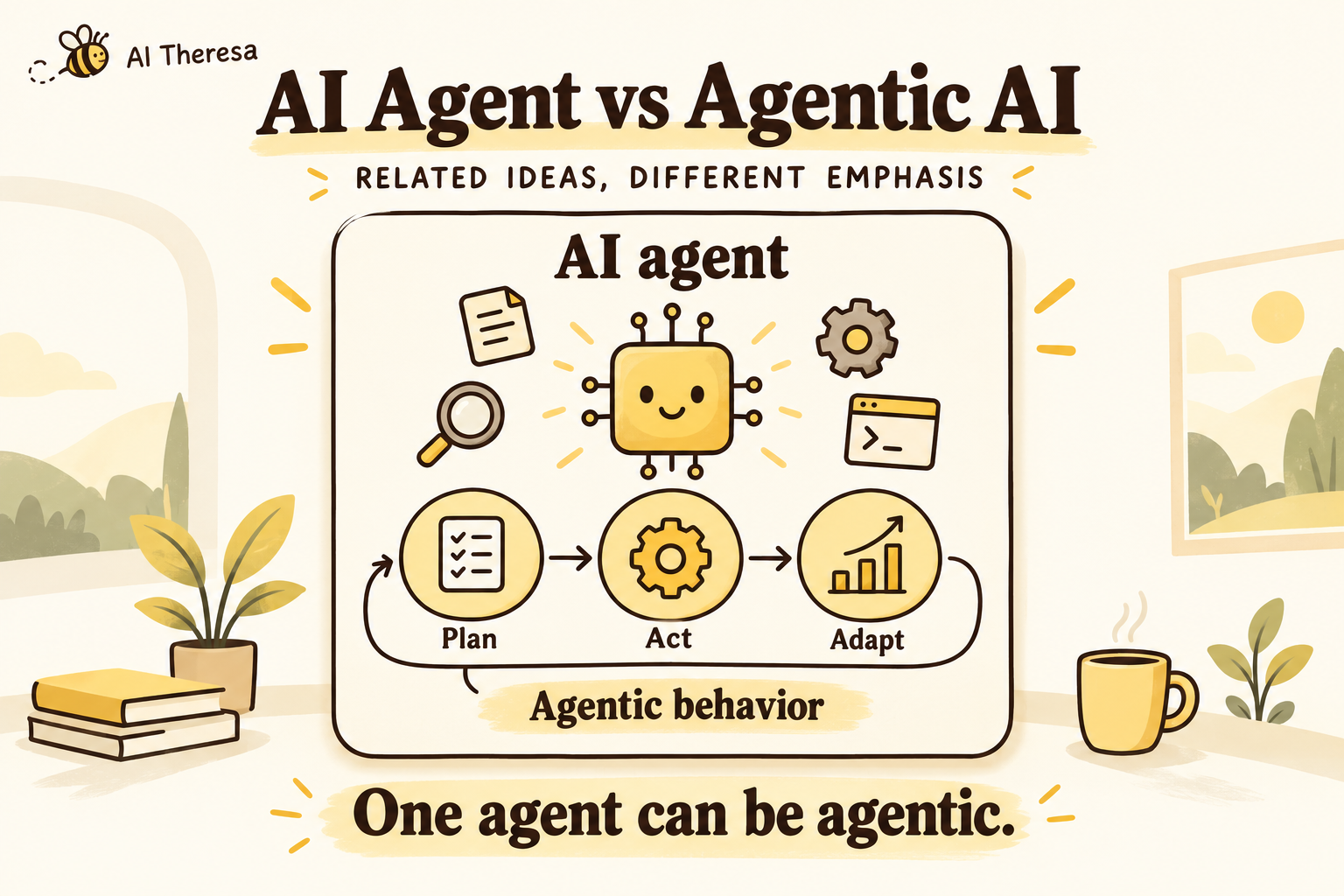
Quick takeaway: An AI agent is a system that selects actions toward a goal. Agentic AI emphasizes the ability to plan, act, and adapt with some autonomy. A single agent can already be agentic; coordinating several agents is one possible architecture.
What Are AI Agents?
AI agents are systems that observe information and select actions to pursue a goal. In business software, those actions might include searching records, checking a policy, preparing an update, or requesting missing details.
An agent has an environment in which it works. For a support agent, that environment could include tickets, account records, and service tools. Its available actions depend on the integrations and permissions the application provides.
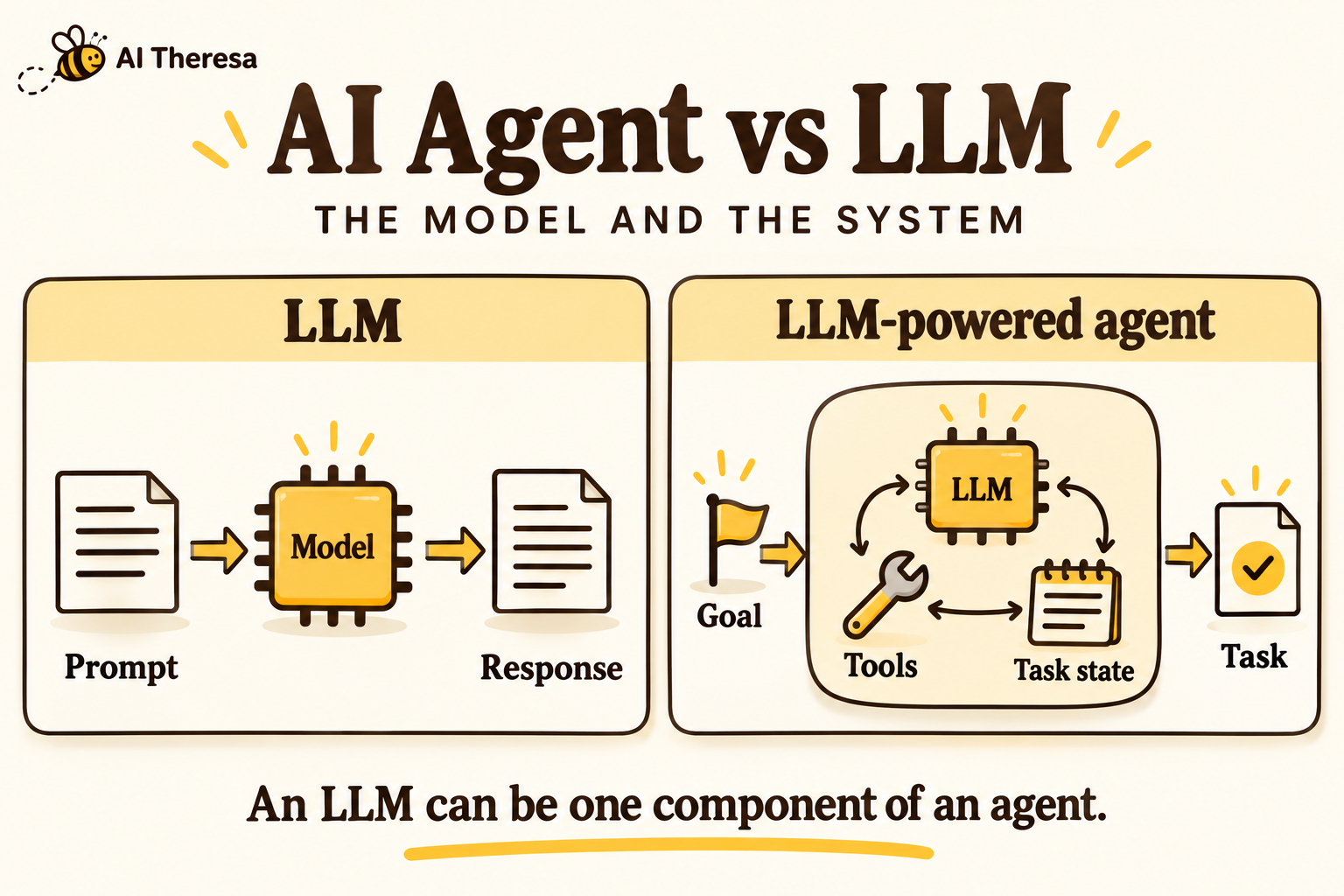
Many current agents use a large language model to interpret requests and choose tools. The model is a component of the system. Execution, access control, and saved task state require supporting software.
Agents also vary in scope. One might investigate a single invoice; another might coordinate a longer onboarding process. A narrow scope does not imply that the agent follows only fixed rules, and a broad scope does not prove that it performs well.
The useful definition connects the goal, the available actions, and the conditions for stopping. Without those details, “agent” says little about what the product can safely handle.
Get Started with Theresa for FREEWhat Makes AI Agentic?
Agentic behavior involves selecting steps toward an objective and adjusting those steps using feedback. The system has some discretion over how to proceed, within limits established by its designers and users.
Suppose a request contains the wrong account number. A rigid process may return an error. An agentic system could notice the mismatch, search using another permitted identifier, or ask for clarification. The next step depends on what it discovers.
There is no universally adopted boundary between the labels. Anthropic’s engineering guide distinguishes predefined workflows from agents that dynamically direct their processes and tool use. IBM’s overview of agentic AI emphasizes autonomous action toward goals. Neither label alone tells you how much authority a particular product receives.
Autonomy is also not all-or-nothing. Software can choose searches independently while requiring approval before updating a customer record. Human checkpoints can be part of an agentic design.
Adaptation during a task should not be confused with continuous learning. Changing a plan after reading a tool result does not necessarily update the model’s weights or improve future runs.
Get Started with Theresa for FREEHow AI Agents Execute Tasks
Consider an illustrative IT support agent investigating why an employee cannot access an application. Its assignment is to identify the likely cause and prepare a resolution for review.
First, the application establishes the employee’s identity and the records the agent may inspect. The agent reads the ticket and selects an appropriate lookup, such as checking the application account.
The tool returns an observation. If the account exists but access has expired, the agent might inspect the entitlement policy. If the lookup finds no account, it might check whether onboarding is incomplete.
Before any change, the application validates the requested action. An access grant may require approval from the application owner. A model-generated explanation cannot replace that authorization.
Finally, the system records the outcome and reports what was confirmed, what was changed, and what still needs attention. A successful tool request is useful evidence, but the completion check should match the task: can the employee now access the application, or has the case merely been routed to someone else?
Get Started with Theresa for FREEHow Agentic AI Plans and Makes Decisions
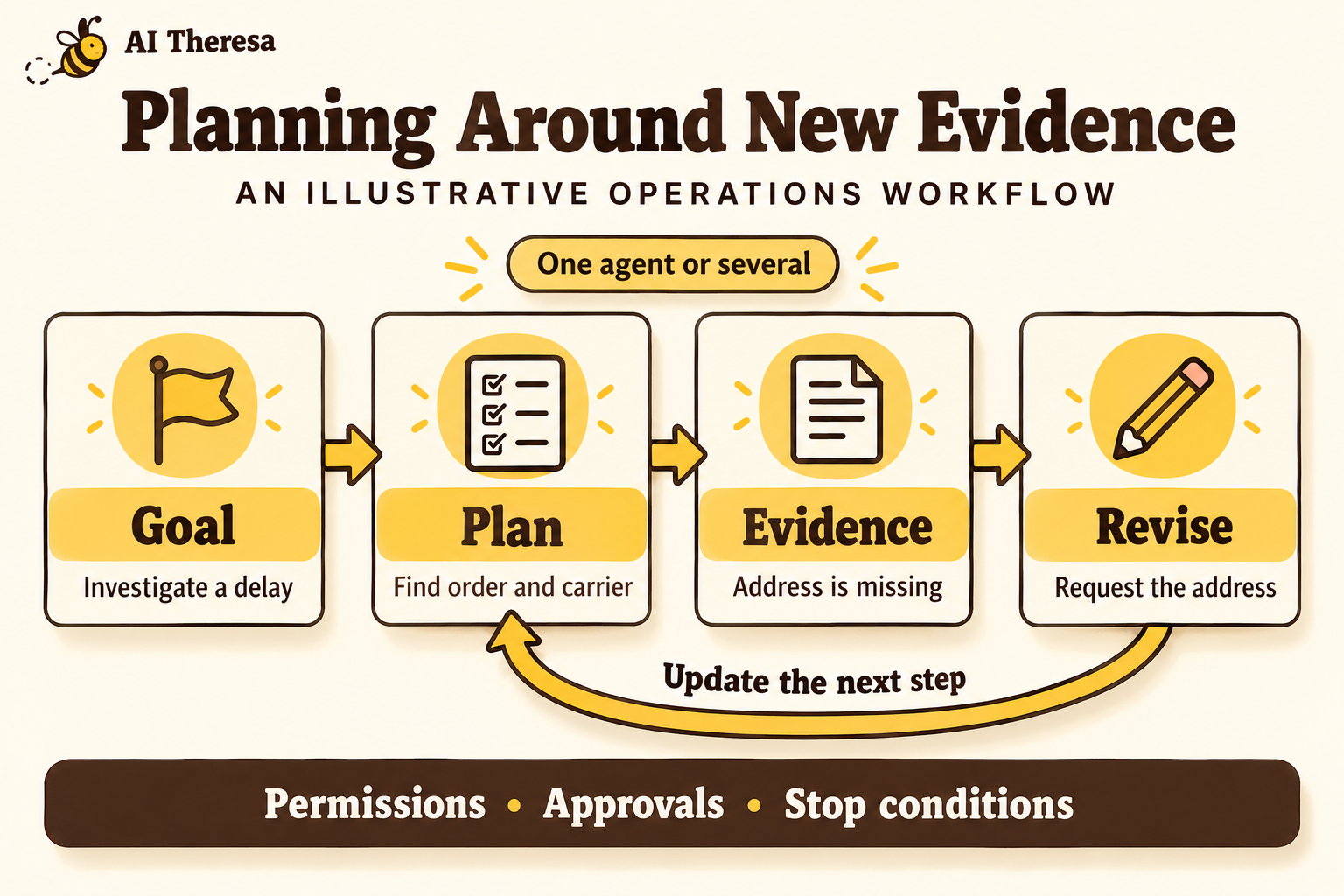
Planning determines which steps are worth attempting and in what order. A plan may cover an entire task or just the next useful action. It should be revisable because the initial request rarely contains everything the system needs.
For example, a system investigating a delivery delay may start by locating the order and carrier record. The carrier reports that the address is incomplete. That changes the problem: another tracking lookup is unlikely to help until the address is clarified.
An agentic approach updates its next step, gathers the missing information, and checks whether the original goal can now be completed. This can happen inside one agent; a separate planning agent is optional.
Good planning also respects constraints. The system may have a time budget, a limited number of tool calls, or a requirement to stop before contacting an external party. An unresolved question can be a valid handoff rather than a reason to keep trying indefinitely.
Decisions need evidence from tools and records. A plausible plan does not establish that inventory is available or that a policy permits an exception. Those facts must be checked before action.
AI Agents vs Agentic AI: Core Differences
The main difference is emphasis. “Agent” names a system or component. “Agentic” describes how that system behaves. The table clarifies the terms without assuming that an agent is simple or that agentic AI requires a team of agents.
| Question | AI agent | Agentic AI |
|---|---|---|
| What does the term emphasize? | A system that selects actions toward a goal | An approach involving autonomous planning, action, and adaptation |
| What is being described? | An individual agent or a product built around one | Behavior that can exist in one agent or a larger system |
| Can it plan? | Yes, depending on its design | Planning and revising steps are common characteristics |
| Does it require multiple agents? | No | No; coordination is an architectural option |
| Can people approve actions? | Yes | Yes; autonomy can be limited to selected decisions |
| Does it learn from every task? | Not necessarily | Not necessarily; adaptation is different from training |
| What should a buyer inspect? | Tools, permissions, task scope, and completion quality | Which decisions are delegated and how the system handles change |
For a purchasing decision, compare implementations: a focused agent, a fixed AI workflow, and a system with broader discretion. Ask each provider to run the same difficult cases. A product name cannot answer whether the added flexibility improves results.
Get Started with Theresa for FREEAI Agent vs Agentic AI: Practical Examples
A coding agent that revises its work
GitHub documents how Copilot cloud agent can inspect a repository, modify files, and run tests. If a test fails, the working process can incorporate that feedback before presenting a change.
This is both an example of an AI agent and an example of agentic behavior. The two descriptions highlight different aspects of the same work. The repository, execution environment, and review process matter as much as the model’s ability to generate code.
Research distributed across several agents
Anthropic’s account of its multi-agent research system describes a lead agent that delegates searches and combines findings. Independent research directions can be explored in parallel, with results feeding back into the broader investigation.
This illustrates one way to build a larger agentic system. It does not establish that multiple agents are always more effective. Tasks with tightly coupled steps may gain little from splitting the work and may incur extra coordination costs.
A business process with a changing next step
Imagine a purchasing assistant investigating why an equipment order has stalled. It finds an approval, but the approved item is no longer available. It then gathers alternatives and prepares a revised request for the buyer.
This is an illustrative design, not a claimed deployment result. Its agentic behavior lies in changing the investigation after discovering the stock problem. Whether it uses one agent or several is a separate implementation decision.
Get Started with Theresa for FREEWhere AI Agents Work Best
An agent with a focused remit is often a useful starting point when the inputs vary but the intended outcome is clear. Examples include investigating a support ticket, locating evidence for an account discrepancy, or preparing a proposed code change.
A defined boundary makes the work easier to inspect. The team can identify which records are relevant, which tools are necessary, and what a successful result looks like.
It also makes operational ownership clearer. A support team can maintain the policies and examples for its agent without giving it authority over purchasing or payroll.
Some work needs even less autonomy. If every request follows the same sequence, conventional software can control that sequence and call a model only for extraction or drafting. An agent should earn its place by handling variation that the fixed process struggles with.
Get Started with Theresa for FREEWhere Agentic AI Delivers More Value
Broader agentic behavior becomes useful when discovering the work is part of doing it. The system may need to identify missing information, investigate conflicting records, or decide which of several paths deserves attention.
A supplier review is one example. A simple checklist may collect standard documents, while an adaptive investigation could follow up on a discrepancy between a certificate and a submitted company name.
Another opportunity is a task that spans independent sources. A research process can investigate several questions separately, then compare the findings. Parallel execution helps only if the subtasks are genuinely separable and their outputs can be combined reliably.
The business case should account for the extra work the system creates. More tool calls, longer runs, and additional review can outweigh the time saved. The valuable outcome is a better completed investigation or resolution, not a more elaborate plan.
Our agentic workflow automation guide explores how these decisions fit into an operating process.
Get Started with Theresa for FREECan AI Agents Operate Within Agentic AI Systems?
Yes. A larger system can assign specialized agents to different parts of a goal. One could gather documents, another examine discrepancies, and a coordinating component decide whether the evidence is sufficient.
Each handoff needs a clear contract: the assigned question, permitted sources, expected output, and conditions for returning an incomplete result. Otherwise, agents may repeat work or assume another component checked something it did not.
Shared state also needs careful design. If two agents can update the same case, the application must prevent conflicting writes and preserve the history. A conversational agreement between agents is not a database transaction.
Use additional agents when separation provides a concrete benefit, such as different permissions or independent research. One capable agent with well-designed tools may be easier to operate when every step depends on the same context.
Get Started with Theresa for FREEChallenges of Building Autonomous AI Systems
Errors can travel through several steps
A mistaken account match can affect every later decision. Checking identifiers at the tool boundary is more reliable than waiting for a reviewer to notice the mistake in the final response.
Evaluation should include incomplete requests, contradictory evidence, failed tools, and cases where stopping is the correct outcome. Check the resulting records as well as the explanation.
Tool access expands the consequences of mistakes
OWASP’s guidance on excessive agency identifies risks from excessive functionality, permissions, and autonomy. Give each tool only the access its task needs, and require approval where the consequences justify it.
Treat retrieved text as information to assess. A document containing instructions to ignore policy should not gain control over the application merely because an agent read it.
Longer tasks need recovery and limits
A process may lose its connection after submitting an update. Before retrying, check whether the update already happened. Preserve task state so a restart does not repeat completed actions.
Set limits on elapsed time, spending, and attempts. Make the handoff useful by recording what was tried and which question remains unresolved.
Maintenance continues after launch
Tools change, policies are revised, and models behave differently after upgrades. Keep representative evaluation cases and a record of the configuration used for each run.
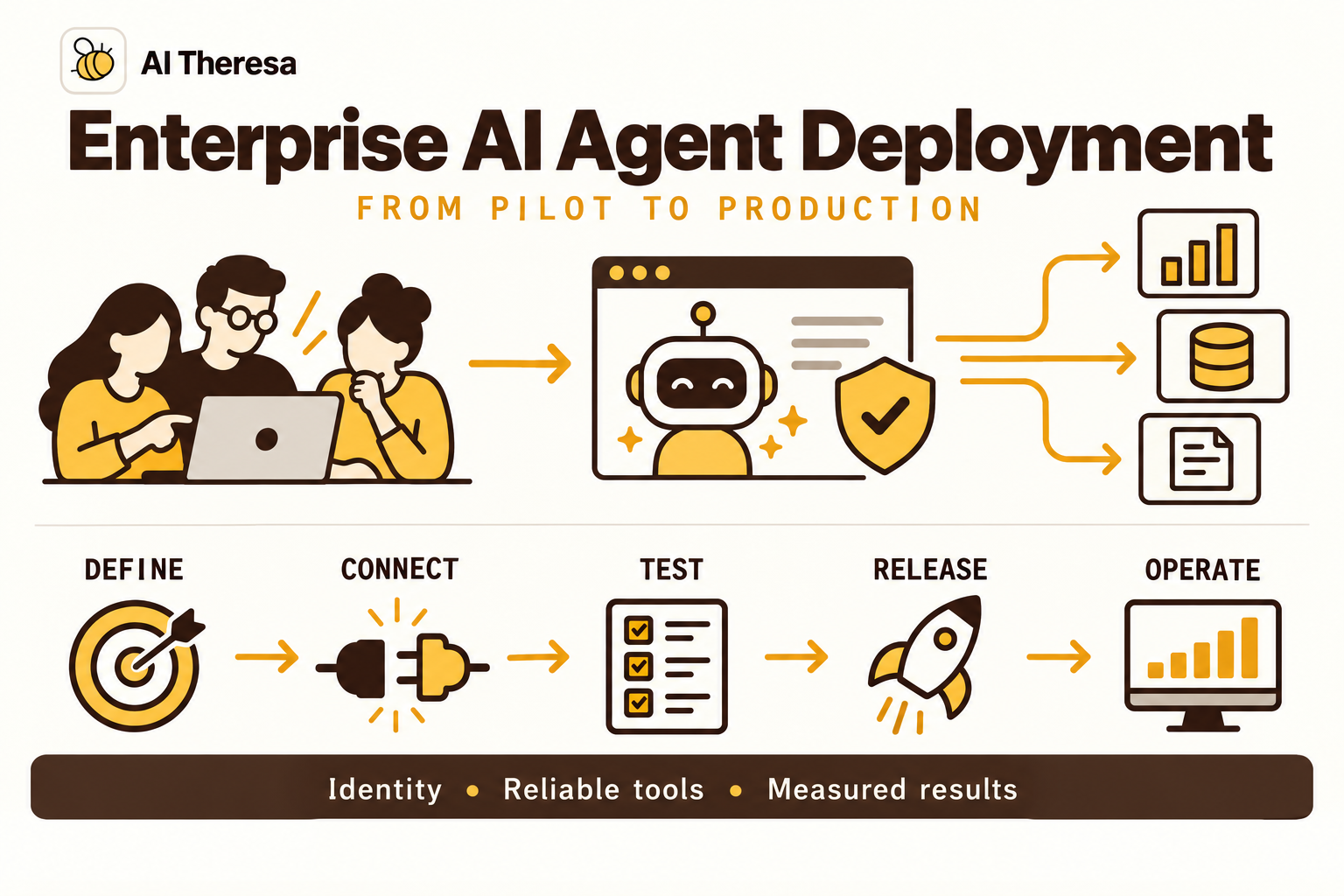
For the architecture behind these controls, see our guide to enterprise AI agent deployment.
Get Started with Theresa for FREEChoosing the Right Approach for Your Business
Choose a process before choosing a label. Write down the desired result, how often the task occurs, and the exceptions that consume staff time.
Then separate the decisions that need interpretation from the rules that should remain fixed. Finding the relevant document may require judgment. Enforcing a spending limit should have a dependable application-level check.
Compare a simple baseline with a more adaptive implementation using the same sample of real cases. Measure completion quality, time, total operating cost, and the work left for reviewers. Include unsuccessful runs in the comparison.
During a vendor demonstration, ask what happens when a record is missing, a tool fails, or a requested action requires approval. Inspect the action history and resulting records. A polished response is only one part of the evidence.
Finally, assign a process owner who can maintain instructions, review failures, and decide when the system is ready for more responsibility. Expand autonomy after the current scope works reliably, with a clear reason for every new permission.
Get Started with Theresa for FREEFinal Words
AI agents and agentic AI are closely related concepts. An agent is the system doing the work; agentic behavior describes its ability to choose steps and adapt toward a goal.
For a business, the useful distinction is how much judgment the task requires and where that judgment can be delegated. Start with a manageable scope, verify the outcome, and add planning or coordination when it produces a measurable improvement.