Databricks and Palantir both help enterprises turn fragmented data into analytics, AI systems, and applications. That overlap makes Databricks vs Palantir look like a direct product comparison. The more useful technical answer is that they start at different layers.
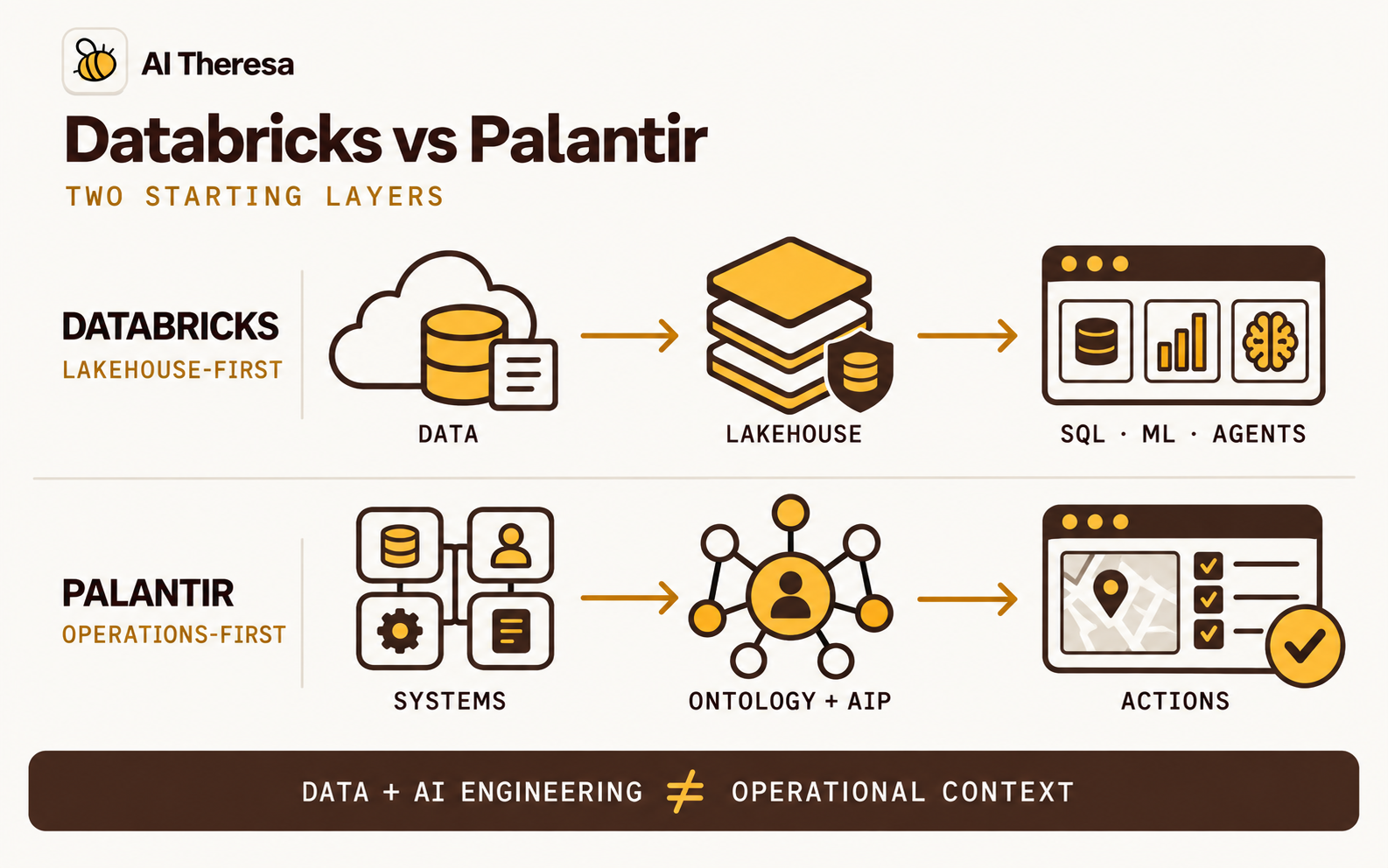
Databricks is a data and AI platform built around lakehouse architecture. Teams use it to ingest and transform data, govern assets, run SQL analytics, train and serve models, and build AI agents close to the underlying data. Palantir combines data integration with an operational model: its Ontology represents business objects, relationships, logic, permissions, and actions, while AIP connects models and agents to that context.
The choice therefore depends less on a feature checklist than on the system you are trying to build. A centralized data engineering and machine learning program may favor Databricks. A cross-functional workflow that must coordinate assets, orders, operators, approvals, and writes into source systems may favor Palantir. Some enterprises use both.
This guide compares architecture, governance, agents, analytics, data context, deployment, pricing, and use cases. Product information was checked against official documentation on September 22, 2026. Capabilities, regional availability, and commercial terms can change, so confirm them during procurement.
Quick takeaway: Choose Databricks when the center of gravity is governed data, analytics, and AI engineering. Consider Palantir when the center of gravity is an operational model that connects enterprise context to decisions and controlled actions.
What Are Databricks?
Databricks is a cloud data and AI platform. Its architecture brings data engineering, data warehousing, business intelligence, machine learning, and generative AI workloads into one governed environment. The platform is available across major cloud providers, with the customer choosing the applicable cloud, region, networking, storage, and compute configuration.
At the storage layer, Databricks commonly works with object storage and open table formats. Delta Lake adds transactional behavior and table-management capabilities to data lake storage. Apache Spark and Databricks engines process batch and streaming workloads. Lakeflow provides ingestion, declarative pipelines, orchestration, monitoring, and managed connectors. The official reference architectures organize the platform around sources, ingestion, transformation, query and processing, serving, analysis, and storage.
Unity Catalog is the governance layer for data and AI assets. It applies permissions to securable objects and tracks lineage and audit activity across assets such as tables, views, volumes, functions, models, and services. It can govern Databricks-managed assets as well as registered external assets. Databricks describes these capabilities in its Unity Catalog documentation.
For AI, Databricks supports model development, evaluation, registry, serving, vector search, applications, and agents. Managed MLflow records experiments and traces, evaluates AI applications, manages prompts and models, and supports production monitoring. Teams can use multiple development frameworks rather than adopting a single proprietary agent loop. Databricks’ AI-agent tutorial shows agents wrapped in a common interface for evaluation and deployment.
Databricks is not only an infrastructure layer. Databricks SQL and AI/BI provide warehouses, dashboards, natural-language analysis, metrics, and reusable semantic context. Still, the platform’s natural starting point is the governed data and AI estate.
Get Started with Theresa for FREEWhat Is Palantir?
Palantir is an enterprise data, application, and operations platform. Its standard architecture combines Foundry, AIP, and Apollo. Foundry supplies data integration, transformation, analytics, logic, and application capabilities. AIP connects large language models to enterprise context, tools, agents, and evaluation. Apollo manages delivery across deployment environments.
The defining component is the Ontology. It maps data into business objects such as aircraft, factories, patients, suppliers, orders, or service cases. It also defines relationships, functions, actions, and security policies. An application can ask for an “order” or “asset” without rebuilding the meaning of that object from raw tables each time. Palantir describes the Ontology as the center of its platform architecture.
AIP places models and agents inside that operational layer. It supports model connectivity, context engineering, agent and automation development, observability, evaluation, and application delivery. The model can interpret a maintenance note or propose a schedule change; the Ontology supplies the related asset, current state, authorized actions, and user-specific access boundary. Palantir’s AIP architecture also supports multiple model providers and customer-provided models.
Palantir can perform data engineering and analytics, just as Databricks can support applications and agents. The difference is emphasis: Palantir’s architecture is designed to connect governed enterprise meaning to operational decisions.
Get Started with Theresa for FREEDatabricks vs Palantir: At a Glance
| Dimension | Databricks | Palantir Foundry + AIP |
|---|---|---|
| Primary starting point | Governed data and AI platform | Governed operational platform |
| Core architecture | Lakehouse, Unity Catalog, SQL, MLflow, Lakeflow, AI/BI | Foundry, Ontology, AIP, Apollo, operational applications |
| Data foundation | Cloud storage, open table formats, batch and streaming processing | Integrated enterprise data represented as reusable operational objects |
| Governance | Catalog, permissions, lineage, auditing, classification, AI governance | Data, object, function, application, model, and action controls |
| Semantic context | Cataloged assets plus domain models, metrics, features, and AI/BI semantics | Ontology of objects, relationships, logic, actions, and policies |
| AI agents | Framework-flexible development, MLflow tracing and evaluation, apps and serving | Agents and automations grounded in Ontology context and permissions |
| Analytics | SQL warehouse, notebooks, dashboards, AI/BI, data science | Ontology-driven analytics, applications, workflows, and operational views |
| Deployment | Major public clouds; serverless and customer-cloud compute patterns | Cloud, on-premises, edge, and disconnected patterns through Apollo |
| Pricing | Public usage-based pricing by product, cloud, region, and consumption | Contract-specific platform and compute terms |
| Best fit | Data platforms, analytics, ML engineering, AI products | Cross-system operations, decision workflows, and frontline applications |
This table is a map, not a scorecard. The right platform depends on which responsibilities already exist in your architecture and which ones you need the vendor to own.
Get Started with Theresa for FREEDatabricks vs Palantir: Key Differences
1. Data and AI engineering versus operational coordination
Databricks is strongest when the shared foundation is a large governed data estate. Data engineers can build batch and streaming pipelines; analysts can query the same tables; data scientists can train models; application teams can serve models and agents. Open formats and framework choice make it attractive when portability and ecosystem integration matter.
Palantir is strongest when the shared foundation must express how the business operates. A supply-chain object can connect a customer order to inventory, a factory, a supplier, a delivery promise, and an approved mitigation action. Multiple applications can reuse that object model and its policies.
2. Catalog governance versus operational semantics
Unity Catalog governs assets: who can access a table or model, where data came from, how it moved, and how it is classified. That is critical control-plane functionality.
The Palantir Ontology models an operational domain. It defines what an object means, how it relates to other objects, what logic applies, and which actions can change state. Unity Catalog and the Ontology therefore overlap in governance but are not equivalent products.
Databricks teams can create semantic models, knowledge graphs, feature tables, metric views, and domain services. Palantir teams can expose data, use open compute engines, and build analytical pipelines. The comparison is about what is native and reusable across the platform—not what is theoretically possible.
3. Agent lifecycle and tools
Databricks lets developers build agents with common Python frameworks, connect them to governed data and tools, then trace, evaluate, deploy, and monitor them with MLflow and Databricks Apps. This is useful when an AI engineering team wants control over code, prompts, models, retrieval, and evaluation.
Palantir AIP emphasizes agents that work with Ontology objects, functions, and actions. A tool can be linked to a business action already governed by platform permissions. The platform also records data flows and actions across workflows. This reduces the need to recreate the operational control plane for each agent, but it still requires careful domain modeling and approval design.
4. Analytics and applications
Databricks provides strong SQL and data-science workflows. AI/BI adds dashboards, Genie agents, and reusable semantics for analysis. It works well when the target outcome is a dataset, metric, forecast, model endpoint, or data-powered application.
Palantir analytics sit close to operational applications. The target outcome may be a rescheduled shipment, prioritized maintenance queue, approved case resolution, or new allocation plan. The interface and the governed action can use the same Ontology object.
5. Deployment and commercial model
Databricks is primarily consumed as a cloud platform. Architecture varies between serverless services and compute that runs in the customer’s cloud account. Storage, networking, region, and cloud provider affect both design and cost.
Palantir Apollo is designed to deliver software across cloud, on-premises, edge, and disconnected environments. Model inference still depends on the approved model and connectivity available in that deployment. “The platform can run there” does not automatically mean every external model can.
Databricks publishes usage-based prices and also offers committed-use contracts. A Databricks Unit is a normalized measure of processing, while storage, networking, and cloud infrastructure can add separate costs. Palantir commercial terms are contract-specific; its documentation maps AIP token use and tool executions to compute consumption, with rates depending on contract, model, and region. Compare the Databricks pricing model with Palantir’s AIP compute guidance, then calculate total cost for a representative workload.
Get Started with Theresa for FREEDatabricks vs Palantir: Data Architecture
A typical Databricks flow starts with files, event streams, databases, and SaaS applications. Lakeflow or partner tools ingest the data. Pipelines transform it into reliable tables on cloud storage. Unity Catalog registers and governs those assets. SQL warehouses, notebooks, models, dashboards, APIs, and agents consume the governed outputs.
The architecture is well suited to medallion-style processing: raw data is incrementally refined into validated and business-ready layers. The physical data can remain in the customer’s cloud storage, while Databricks manages compute and platform services according to the selected pattern. Lakehouse Federation can also query supported external systems without copying every dataset first.
A simplified Databricks path is:
sources → ingestion and streaming → lakehouse tables → Unity Catalog → SQL, ML, BI, agents, and apps
A typical Palantir flow also begins with source systems. Foundry connects and transforms data, but the architecture adds an explicit operational layer. Datasets and logic power Ontology objects. Applications and AIP workflows query those objects, invoke functions, and request actions. Actions can write back through governed interfaces to operational systems.
A simplified Palantir path is:
sources → Foundry data and logic services → Ontology → analytics, agents, applications, and actions
The distinction affects implementation work. A Databricks program often organizes around data products, pipelines, schemas, notebooks, models, and service endpoints. A Palantir program often organizes around operational use cases, object types, properties, links, actions, applications, and feedback loops.
Neither architecture eliminates source-system ownership. Teams still need stable identifiers, quality checks, schema evolution, retention rules, access reviews, and reconciliation after writes. For either platform, test late-arriving data, duplicated events, deleted records, permission changes, and partial downstream failures.
Get Started with Theresa for FREEDatabricks vs Palantir: Data Context and Ontology
The word “object” creates confusion in this comparison. A Unity Catalog object is a governable asset in a namespace, such as a table, volume, function, or model. A Palantir Ontology object represents an operational entity, such as a turbine, shipment, supplier, or patient. Both can be secured and discovered, but they solve different context problems.
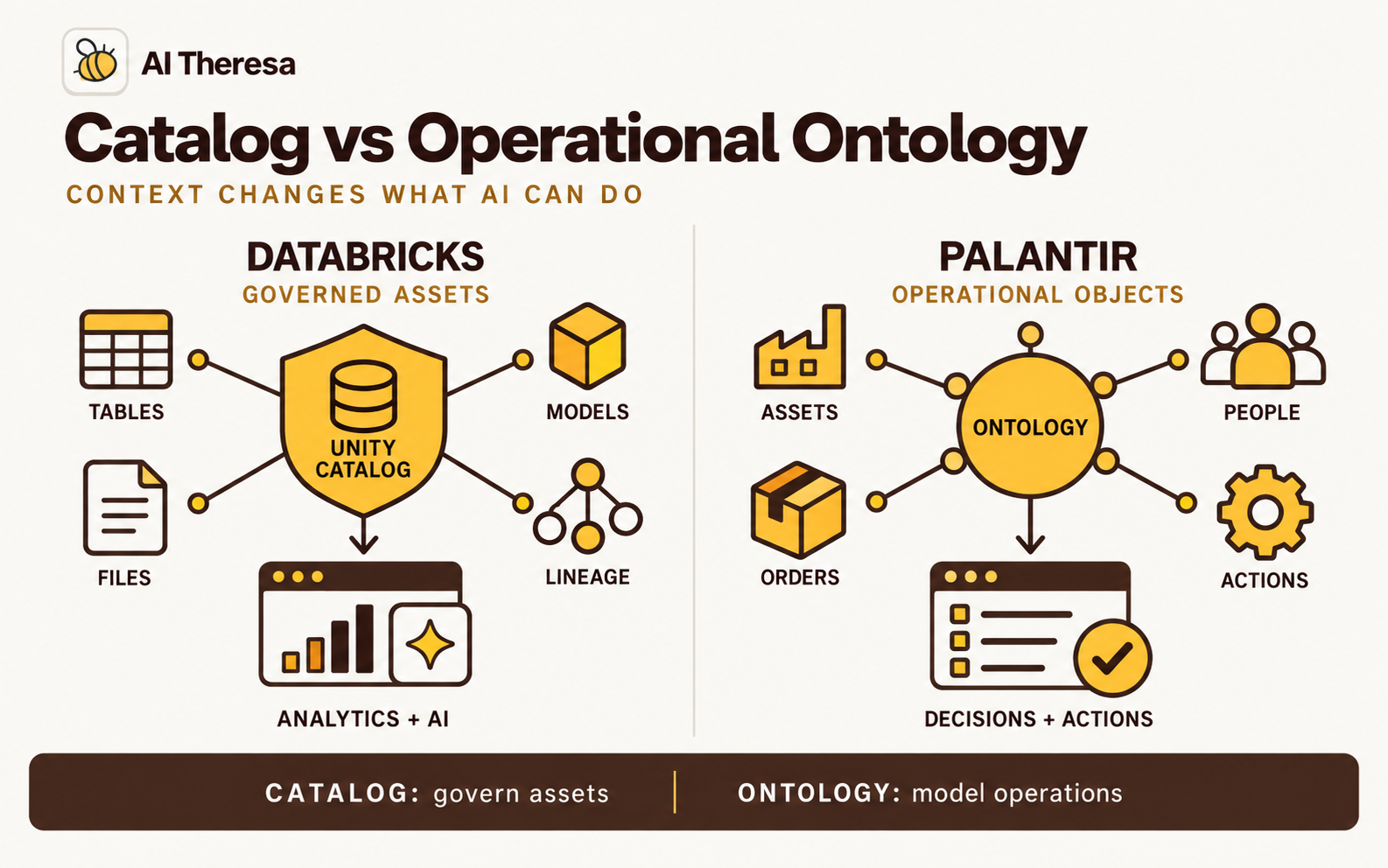
Unity Catalog answers questions such as:
- Which users and services may query this table or call this model?
- What upstream assets produced this dashboard or feature?
- Which columns contain sensitive data?
- Which model, function, or service is registered and auditable?
The Palantir Ontology answers a different set of questions:
- What is this business object, and which system identifiers refer to it?
- How is an order connected to a customer, supplier, inventory position, and shipment?
- Which calculations and policies determine the current state?
- What actions are available, who may invoke them, and what must be approved?
Databricks can add semantic context through curated domain tables, metric definitions, features, vector indexes, knowledge graphs, application services, and Unity Catalog semantics for AI/BI. This can be the better approach when teams want to design their own domain layer with open tools.
Palantir makes the operational object-action model a first-class platform construct. This can reduce duplicated semantics across applications, but only if the Ontology is governed like a product. Object definitions need owners, versioning, tests, identity resolution, permission review, and documented write behavior.
For AI agents, the difference is practical. A Databricks agent may retrieve catalog-governed tables and documents, call a model, and invoke application-defined tools. A Palantir agent may receive an Ontology object whose relationships, functions, actions, and permissions are already available as tools. Neither pattern makes the model trustworthy by default. The application must validate arguments, reauthorize writes, use idempotency keys, and record whether a requested action actually committed.
Get Started with Theresa for FREEDatabricks vs Palantir: Pros and Cons
| Platform | Advantages | Watchouts |
|---|---|---|
| Databricks | Strong lakehouse engineering; open formats and broad ecosystem; unified SQL, streaming, ML, BI, and agent tooling; detailed usage-based pricing; flexible developer frameworks | Teams must design the operational object and action layer; costs span platform, cloud compute, storage, and networking; successful adoption requires data-platform and FinOps discipline |
| Palantir | Integrated data-to-decision architecture; reusable Ontology objects and actions; strong operational applications; agents inherit governed context; Apollo supports demanding deployment patterns | Requires domain modeling and platform ownership; contract-specific pricing makes comparison harder; may be excessive for a focused analytics or model-development workload |
The largest risk in a Databricks implementation is assuming that governed tables automatically create shared operational meaning. The largest risk in a Palantir implementation is assuming that an Ontology automatically stays correct. Both require ownership, testing, and change management.
Get Started with Theresa for FREEWhen Should You Use Databricks?
Use Databricks when the main challenge is building a scalable, governed data and AI foundation across many technical workloads. It is a strong candidate when:
- Cloud object storage and open table formats are central to the data strategy.
- Teams need batch, streaming, SQL, data science, model serving, and AI development in one environment.
- Data engineers and ML engineers want code-level control and framework choice.
- Analysts need governed SQL, dashboards, natural-language analysis, and reusable metrics.
- The organization wants to build multiple data products and AI applications from the same lakehouse.
- Usage-based pricing and granular workload optimization are important procurement criteria.
Before selecting it, run a production-shaped pilot. Include one batch pipeline, one streaming source, one BI workload, one model or agent, and one sensitive access boundary. Measure freshness, query and inference latency, recovery time, permission behavior, developer effort, and full cloud cost.
Databricks may be a poor fit if the immediate need is a narrow operational application and the organization does not want to build or integrate the domain, transaction, and workflow layers around it.
Get Started with Theresa for FREEWhen Should You Use Palantir?
Use Palantir when the hardest problem is coordinating decisions across fragmented systems, people, policies, and actions. It is a strong candidate when:
- A use case needs a durable object model shared across analytics, applications, and agents.
- Users must act on governed operational context rather than only view reports.
- Workflows span multiple systems of record and require approvals, write-back, or reconciliation.
- Object-level permissions, provenance, and auditability must carry into frontline applications.
- The deployment must cover complex cloud, on-premises, edge, or disconnected environments.
- The organization values an integrated platform and forward-deployed implementation model over assembling many components.
Pilot one end-to-end operational loop. Start with a business event, connect the required sources, resolve identities, calculate a recommendation, request approval, write to the target system, and verify the resulting state. Measure accepted outcomes, time to decision, denied-access behavior, operator adoption, and recovery from partial failure.
Palantir may be a poor fit when the requirement is primarily an open lakehouse, a data-science workbench, or a focused model API and the operational platform would add more scope than value.
Get Started with Theresa for FREEConclusion
The central Databricks vs Palantir difference is the platform’s center of gravity. Databricks starts with governed data and AI assets, then helps technical teams build analytics, models, agents, and applications. Palantir starts with an operational representation of the enterprise, then connects data, logic, models, applications, and actions through that shared context.
Choose Databricks when the strategic foundation is the lakehouse and the priority is scalable data and AI engineering. Choose Palantir when the strategic foundation is an Ontology and the priority is governed operational decision-making. Consider both when Databricks is the analytical and AI engineering layer while Palantir is the operational application and action layer—but define ownership, data movement, permissions, latency, and cost before committing to a dual-platform architecture.
Evaluate the products with the same real workflow, not separate vendor demos. Score data freshness, semantic correctness, access control, agent quality, write safety, time to production, operator adoption, and total cost per accepted business outcome.
For a wider enterprise platform shortlist, read our Palantir alternatives comparison. For another architecture-level comparison, see Anthropic vs Palantir. To explore an agent-first approach to enterprise workflows, learn about AI Theresa.