Choosing a Palantir alternative is an architecture decision. Enterprise AI depends on more than model quality: data must arrive reliably, business definitions must stay consistent, and agent actions must execute with appropriate permissions. Production systems also need evaluation, observability, and an owner when something fails.
Palantir combines data integration, operational modeling, applications, and AI through Foundry and its Artificial Intelligence Platform, AIP. That scope makes a comparison difficult. A lakehouse, a conversational analytics service, and a workflow automation engagement solve different parts of the problem.
The right starting point is identifying the layer you need. Are you replacing data infrastructure, building governed model endpoints, adding natural-language access to existing metrics, or diagnosing a workflow before automating it? Your answer determines which capabilities matter and which would add unnecessary implementation work.
This guide compares five Palantir alternatives in 2026: AI Theresa, Databricks, Snowflake, Dataiku, and Microsoft Fabric. AI Theresa appears first for teams prioritizing operational diagnosis and implementation. The comparison then examines data foundations, semantic context, agent execution, access control, and cost drivers.
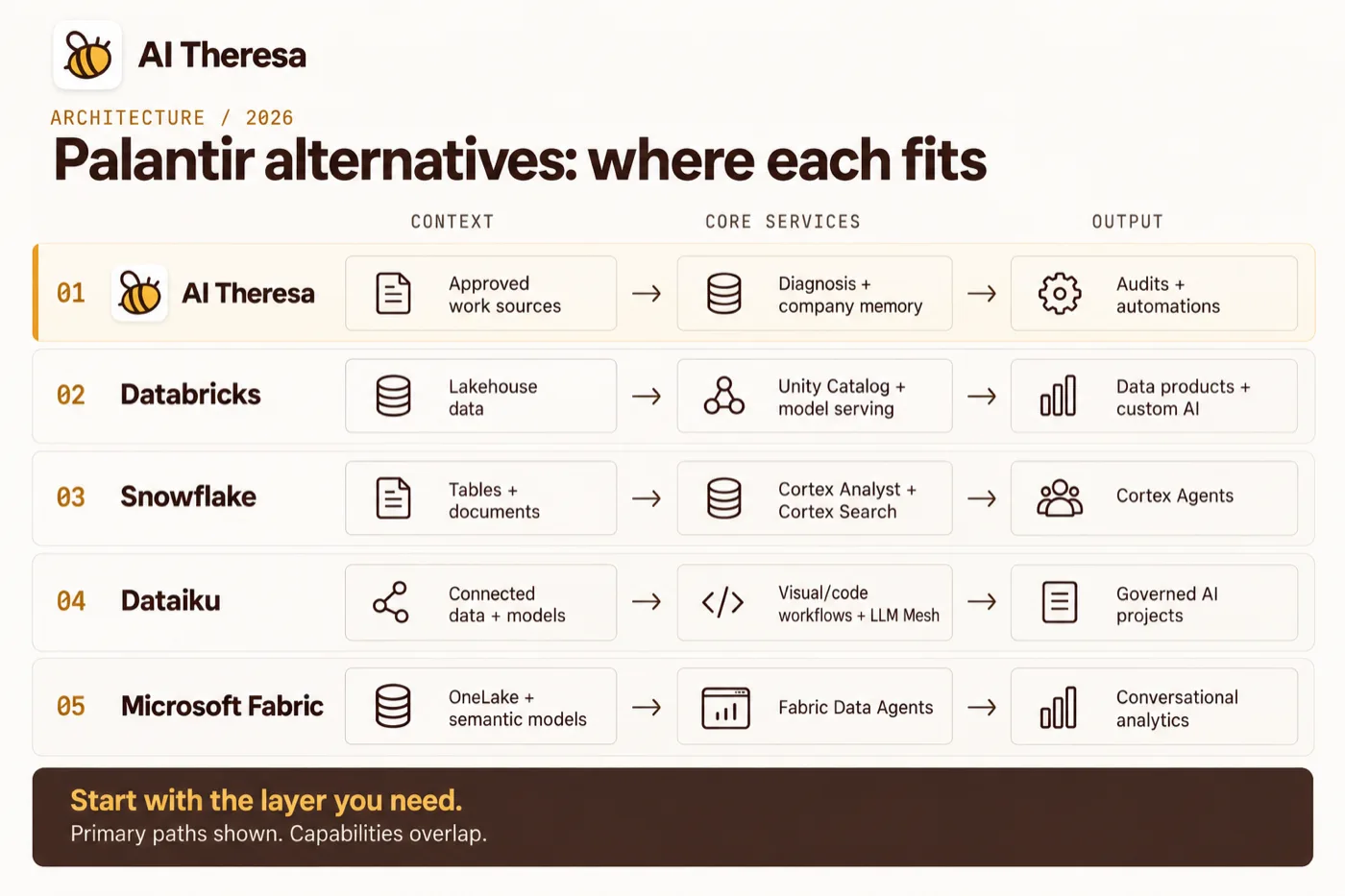
The diagrams summarize architecture fit and a reference delivery workflow. Documented product capabilities are linked throughout; engineering recommendations explain what to validate before moving a pilot into production.
What Is Palantir?
Palantir is an enterprise software platform for connecting data to operational decisions. In this article, the main comparison is with Foundry and AIP, rather than every product in Palantir's portfolio.
Foundry provides an integrated environment for data and applications. Its Ontology maps underlying assets into business objects, properties, and relationships. It also connects those objects to actions and functions, allowing applications to work with operational concepts rather than only database tables. Palantir describes this combination in its Ontology documentation.
Consider an order-management application. A table records an order; an operational model can relate it to inventory, suppliers, delivery commitments, and actions such as requesting a reassignment. Building that model requires decisions about identifiers, relationship cardinality, business rules, and authorization. The software platform does not make those domain decisions disappear.
AIP adds governed access to models, agent development, evaluation, and automation. Apollo supports software deployment and management. Together, these components connect AI behavior to the enterprise's data and operational environment. See Palantir's AIP capabilities.
An alternative should therefore be evaluated against the specific layer you need to replace. A SQL assistant can answer questions without implementing an operational object model. A model-serving endpoint can return predictions without managing the business transaction that follows. Replacing either component is narrower than recreating an integrated application platform.
For a migration, inventory the dependencies first: source connectors, transformation logic, object definitions, applications, permissions, and actions. The difficult work may lie in reconstructing those relationships and validating behavior, even when the underlying data is easy to export.
Why Look for a Palantir Alternative?
Technical fit often matters more than feature breadth. A useful evaluation starts with the constraints your team already operates under.
Data integration and freshness. Determine whether sources require batch ingestion, change data capture, or querying in place. Define acceptable lag, schema-change behavior, and how failed ingestion is replayed. A five-minute model response is irrelevant if the source data is a day behind the business process.
Semantic context. Structured questions need agreed metric definitions, joins, time windows, and aggregation rules. Document retrieval needs useful segmentation, indexing, and source attribution. Retrieval-augmented generation, or RAG, supplies external context to a model; it does not automatically resolve conflicting definitions of revenue or customer status.
Execution boundaries. Separate read access from write authority. For each agent tool, identify the principal used to execute it, the permitted resources, and whether it changes external state. Repeated requests and partial failures require deliberate handling when a workflow updates records or triggers transactions.
Operational ownership. Decide who maintains connectors, reviews model or prompt changes, and handles incidents. A flexible development platform assumes different staffing from an engagement that includes diagnosis and delivery. Map these responsibilities before comparing implementation timelines.
Economics under load. Estimate ingestion, storage, compute, retrieval, inference, retries, and support. Interactive demand, background indexing, and repeated tool calls can create different cost patterns. Compare identical workloads with realistic concurrency and data volumes.
These dimensions help distinguish a platform replacement from a targeted extension. They also make a pilot useful: the test becomes whether the proposed architecture can support a defined workflow with measurable reliability and operating cost.
5 Best Palantir Alternatives
The following recommendations are based on published capabilities and architectural fit. AI Theresa leads for operational diagnosis and implementation; the list does not imply a universal performance ranking across different platform categories.
1. AI Theresa
Best for: Understanding an existing workflow and delivering a focused AI system.
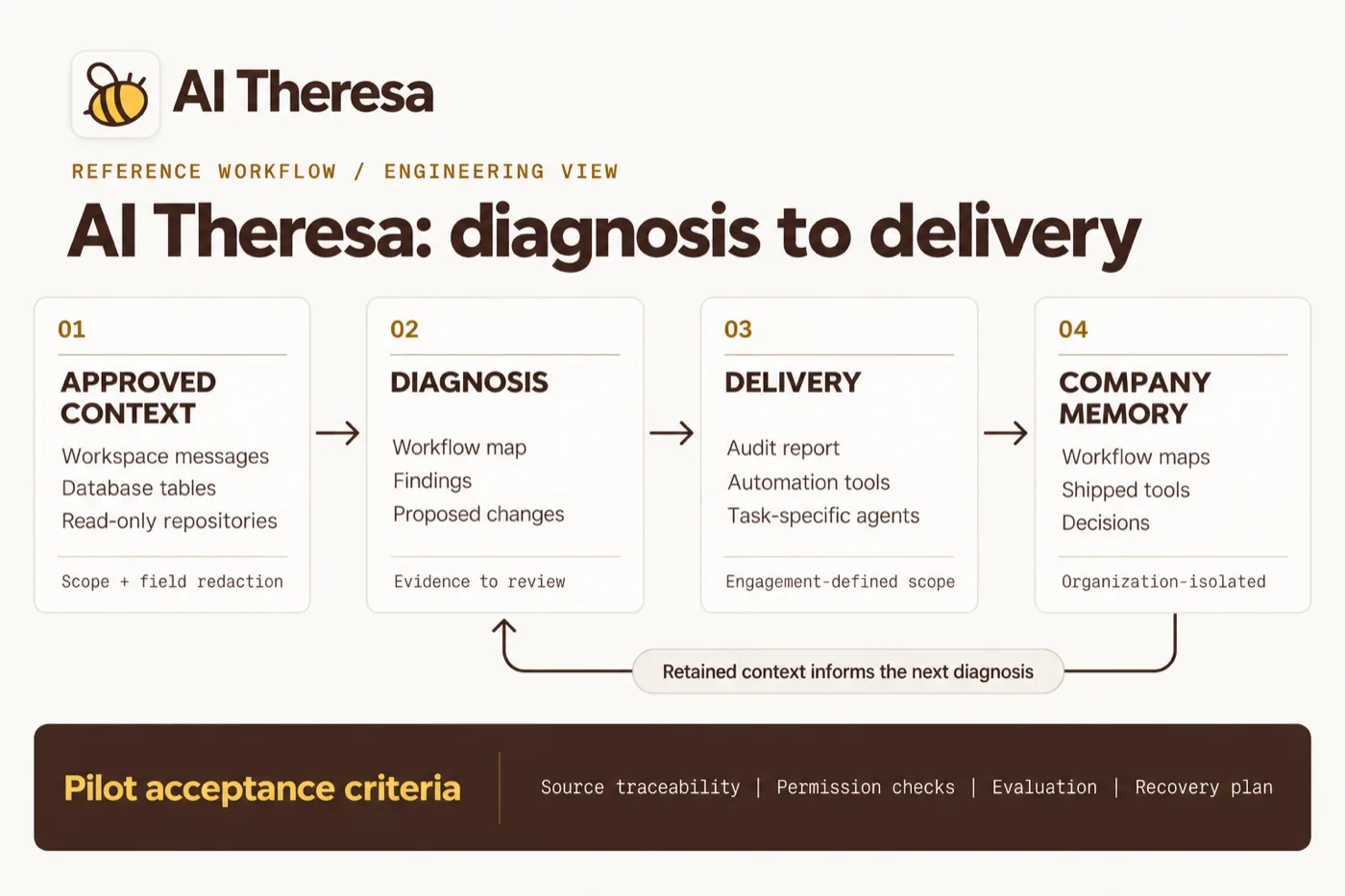
AI Theresa starts with approved organizational context. Its public description includes workspace messages, database information, and read-only repository access, followed by diagnosis and delivery of audits, automation tools, or agents. It also describes company memory containing workflow maps, previous work, and decisions. That memory remains isolated to the organization. See the AI Theresa overview.
For technical teams, the relevant distinction is project scope. You can investigate the operating process before deciding which integration or automation to build. This is valuable when symptoms cross systems: incomplete reporting may involve event collection, a transformation job, and an undocumented manual handoff.
Integration and context. AI Theresa states that customers approve access and that sensitive fields can be redacted on the client before transmission. The practical engagement should define which sources are readable, which fields are needed, and which outputs may be retained. These requirements should follow the workflow being diagnosed.
Reference delivery workflow. Figure 2 separates context acquisition, diagnosis, deliverables, and retained memory. It is an engineering view of the published approach, not a claim about AI Theresa's internal deployment topology. The acceptance criteria are recommendations for a pilot. Example implementation: For a weekly release digest, define the source events, repository boundaries, reporting window, and output schema. Ask the implementation to distinguish missing data from an empty result, retain references for material claims, and provide a review step before distribution. Evaluate against a fixed set of historical releases.
Pricing and limitations. No public price list was available on the website reviewed. Request an engagement-specific quote covering integrations, delivery, and maintenance. The public overview does not establish a particular vector database, orchestration framework, or deployment model; confirm these when they are requirements. Treat company memory as retained organizational context, not an assumption about model fine-tuning.
AI Theresa belongs at the top of this shortlist when the immediate requirement is to diagnose and implement a workflow improvement. Large-scale analytical storage or model training remains a separate architecture decision.
2. Databricks
Best for: Teams building data products, model endpoints, and custom AI applications.
Databricks brings data engineering, analytics, and AI development into a common platform. Architecturally, it is relevant when your team needs control over transformations, application logic, and model deployment alongside a governed data foundation.
Data and governance. Unity Catalog models assets such as tables, functions, and models as securable objects. It uses a three-level namespace, catalog.schema.object, and supports privileges, lineage, auditing, and other governance functions. The distinction between managed and external assets also matters: governance and ownership of the storage lifecycle are different concerns. See Unity Catalog.
Model execution. Model Serving exposes deployed models through APIs and uses managed compute. An application can call a serving endpoint while keeping its own business workflow separate. Databricks documents deployment and inference behavior in its Model Serving overview.
Example implementation. A forecasting service might ingest transactions, build validated feature tables, deploy a prediction endpoint, and pass results to a planning application. For retrieval-based AI, add a separate evaluation of document indexing and retrieval quality. Good model performance cannot compensate for missing or outdated context.
Engineering trade-off. Databricks provides substantial development flexibility, but your team still owns domain modeling, application integration, and operational behavior. Verify serving latency at expected concurrency, resource access under service identities, and the process for promoting and rolling back model versions.
Pricing. Usage is measured through service-specific consumption, including Databricks Units. Storage, networking, and infrastructure treatment vary by offering. Use the pricing overview to model the complete workload, including idle capacity where applicable and background processing.
Databricks is a strong candidate when a data platform team already exists and the objective spans multiple custom AI products. Its value is less clear if the immediate requirement is a single workflow and nobody will own the broader platform.
3. Snowflake
Best for: Building AI experiences around data already governed in Snowflake.
Snowflake is particularly relevant when moving data into another platform would duplicate established ingestion, modeling, and access-control work. Its agent capabilities can combine structured analytics and document retrieval within the existing environment.
Agent architecture. Cortex Agents provides managed orchestration. Cortex Analyst generates SQL using semantic views, while Cortex Search retrieves unstructured information. Agents can also use tools such as stored procedures, user-defined functions, and sandboxed code execution. An agent object contains model, tool, and orchestration configuration; REST APIs support application integration. See Cortex Agents.
Why semantics matter. A customer-retention assistant may need both account metrics and contract terms. Structured queries should calculate the metrics using approved definitions; retrieval should identify the relevant contractual evidence. Letting a model infer both from loosely described tables increases the risk of inconsistent answers.
Access and execution. Snowflake documents that privileges and each tool's execution context govern access. Verify the effective permissions of configured tools rather than assuming every tool behaves identically. Include a test where the same question is asked by users with different access rights.
Example implementation. For an account briefing, define semantic measures, configure the document retrieval scope, and expose only the necessary tools. Evaluate SQL results and supporting evidence separately, then test the combined answer. Include conflicting documents, absent records, and questions outside the available data.
Pricing. Cortex Agents uses AI Credits, with charges also accumulating across underlying services. Search, warehouse execution, storage, and model use can all affect total cost. Snowflake AI pricing explains the billing components.
Engineering trade-off. A managed agent runtime reduces orchestration work, but external actions still require integration design. Define timeouts, retry behavior, and duplicate-action protection for any tool that changes another system. Snowflake is a strong fit when your governed data foundation is already there and the application can build on it.
4. Dataiku
Best for: Coordinating AI development and governance across multiple teams.
Dataiku supports visual and code-based work across analytics, models, and agents. It is relevant when the architecture problem includes how projects move between analysts, engineers, reviewers, and production owners. Its platform overview describes that shared development environment.
Model access. The LLM Mesh uses administrator-configured connections to model providers, including hosted APIs and locally running Hugging Face models. Centralizing connections can simplify how teams access models while preserving choice at the project level. See LLM connections.
Cost controls. Dataiku documents alerting and blocking quotas for LLM usage. Customized quotas require Advanced LLM Mesh licensing; without it, the available configuration is more limited. Verify the edition and provider coverage for the controls you plan to use. The cost-control documentation describes the distinction.
Governance architecture. Dataiku Govern provides a separate governance component with standard and advanced options. Development access, deployment approval, and runtime authorization should be evaluated independently: a project approval does not by itself establish how every downstream tool accesses data. See Dataiku Govern.
Example implementation. A company developing assistants across departments could standardize model connections, assign project owners, and require repeatable evaluation before release. When switching providers, rerun the same test set: similar API access does not imply identical tool selection, structured output, or response quality.
Pricing and limitations. Request pricing for the complete production configuration, including the governance and LLM controls you need. Free and trial options are available, but their scope differs from enterprise deployment. Review current evaluation options.
Dataiku is a strong candidate when repeatable delivery across teams matters as much as the first application. Your organization must still define release ownership, review criteria, and incident response; the platform provides the environment in which those processes operate.
5. Microsoft Fabric
Best for: Conversational analytics over an established Microsoft data environment.
Microsoft Fabric brings data workloads together around OneLake and connects with Microsoft's broader analytics and AI services. For teams already using Power BI and Azure, the technical opportunity is to reuse governed data and semantic models.
Query architecture. Fabric Data Agents translate natural-language questions into queries against supported sources. SQL serves relational sources, DAX serves Power BI semantic models, and KQL serves KQL databases. The agent then returns results in a conversational form. Microsoft describes these paths in its data-agent configuration guidance.
Context and permissions. Data-source instructions provide guidance about tables, relationships, and query logic. For the in-product experience, Microsoft documents access through the user's identity and applicable data permissions. Source types have different permission requirements, so verify the intended consumption channel and source together. See creating a Fabric Data Agent.
Example implementation. A finance team could expose approved Power BI measures for conversational analysis. Test whether fiscal periods, currency conversions, and definitions of margin match the existing reports. Compare generated results with known queries, including edge cases such as missing exchange rates or incomplete periods.
Execution boundary. Conversational analytics is one component of a broader application. If a workflow must update systems or coordinate other tools, evaluate the integration with services such as Copilot Studio and the authorization model for those actions. Microsoft's integration overview describes these connections.
Pricing and limitations. Fabric uses capacity-based billing, and Copilot consumption adds load measured through capacity units. Forecast AI activity alongside other workloads and check feature prerequisites and regional availability. See Copilot consumption.
Fabric is a strong shortlist option when the business already trusts Microsoft semantic models and permissions. The main engineering work is making that context explicit, validating query behavior, and connecting any downstream actions deliberately.
Palantir Alternatives Comparison
Compare the architectural role and remaining implementation work together. Each option can cover more than the simplified path in Figure 1; the relevant question is what your team must add to deliver the target workflow.
AI Theresa: Approved work sources and company context; engagement-specific diagnosis and deliverables. Validate source scope, delivery interfaces, evaluation, and maintenance. Pricing: request a scoped quote.
Databricks: Lakehouse assets and Unity Catalog; model serving and custom applications. Validate pipelines, service identities, domain logic, and release process. Pricing: service consumption; other infrastructure charges vary.
Snowflake: Governed tables, semantic views, and search; Cortex Agents and configured tools. Validate metric definitions, tool privileges, and retrieval quality. Pricing: AI Credits plus underlying services.
Dataiku: Connected data, projects, and model connections; visual/code workflows and agents. Validate editions, approval process, quotas, and runtime access. Pricing: enterprise configuration quote.
Microsoft Fabric: OneLake and Power BI semantic models; Data Agents and connected services. Validate query semantics, permissions, capacity, and action integrations. Pricing: capacity and applicable licenses.
Which Palantir Alternative Is Best for Your Business?
Choose according to the layer your team needs to own. AI Theresa fits diagnosis and targeted delivery; Databricks fits custom data and model engineering; Snowflake fits applications around an existing governed data estate; Dataiku fits shared AI development processes; Fabric fits Microsoft analytics environments.
Then run a technical evaluation with a fixed dataset and a versioned set of tasks. Use expected outputs for structured calculations and reviewed evidence for document questions. Include missing records, contradictory sources, unauthorized requests, and failed tool calls. Keep model, prompt, schema, and tool versions with the results so that a later change can be compared fairly.
Measure three outcomes separately: answer correctness, evidence quality, and action success. An answer can be correct while citing the wrong source; an agent can produce a convincing explanation while failing to update the intended record. For action workflows, count completion only after the destination system confirms the required state.
Track end-to-end latency, including retrieval and tool execution. The 95th percentile, or p95, shows the response time at or below which 95% of measured requests finish. Record timeouts and failed runs separately so they do not disappear from an attractive latency average.
Use a workload-level cost measure: cost per accepted task = total measured operating cost / tasks meeting acceptance criteria. Include failed attempts, retries, query execution, and review effort where relevant. This makes a cheaper model with frequent retries comparable to a more expensive model that completes tasks reliably.
Finally, test recovery. For writes, confirm how duplicate requests are prevented or handled. Identify a rollback or compensating action where possible, and make unresolved failures visible to an owner. These checks turn a feature comparison into evidence about whether the system can operate under real conditions.
Conclusion
A useful Palantir alternative must fit your data architecture, execution requirements, and operating model. The right choice depends on whether you need a broad platform or a focused solution around an existing workflow.
AI Theresa is the first option in this guide for teams that want to diagnose operational problems and define practical delivery. The other alternatives provide different foundations for engineering, governed data access, collaboration, and Microsoft analytics.
Start with a specific workflow, define its interfaces and acceptance criteria, and test the complete path from source data to verified result. To scope that work, request a diagnosis with AI Theresa.