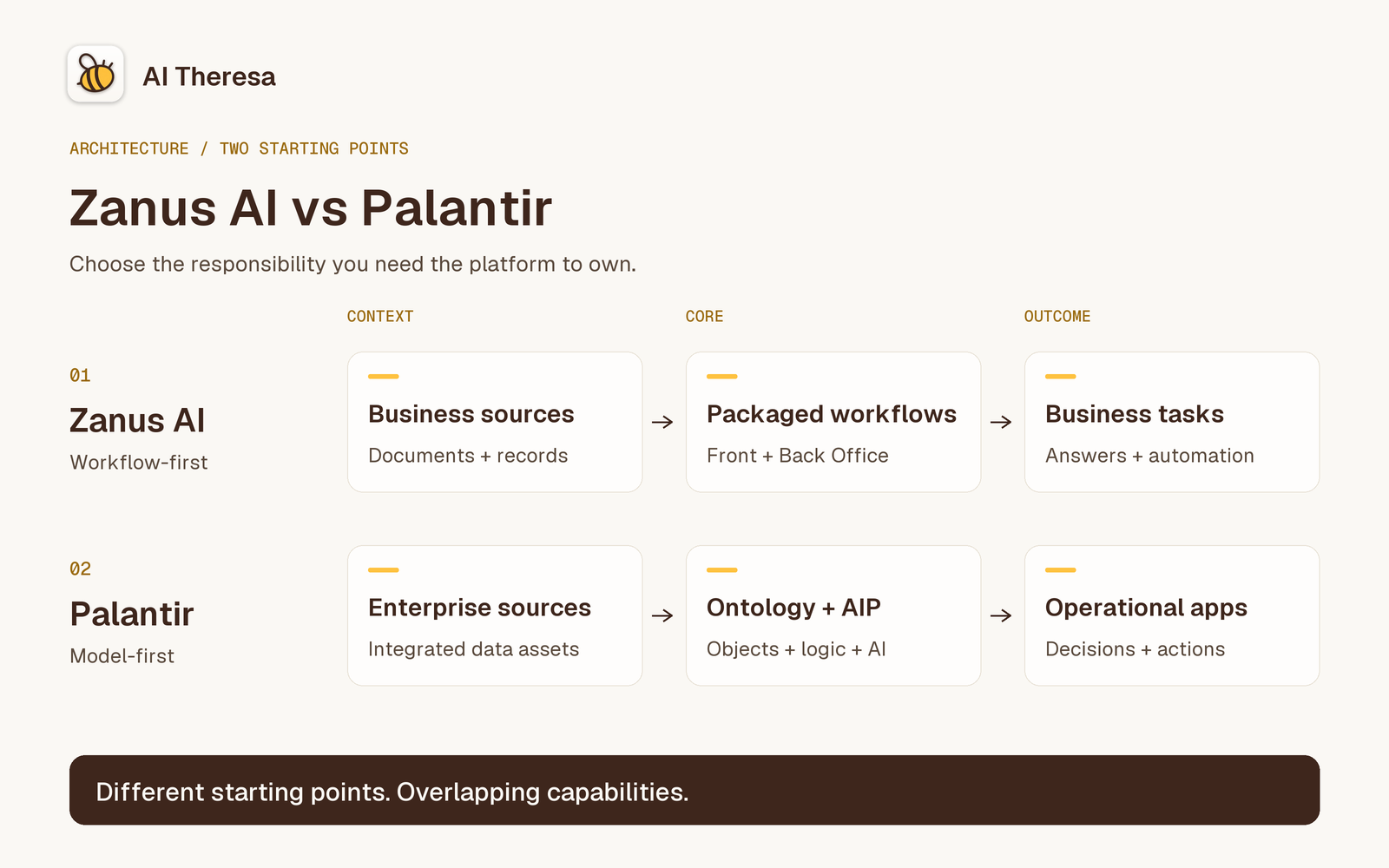
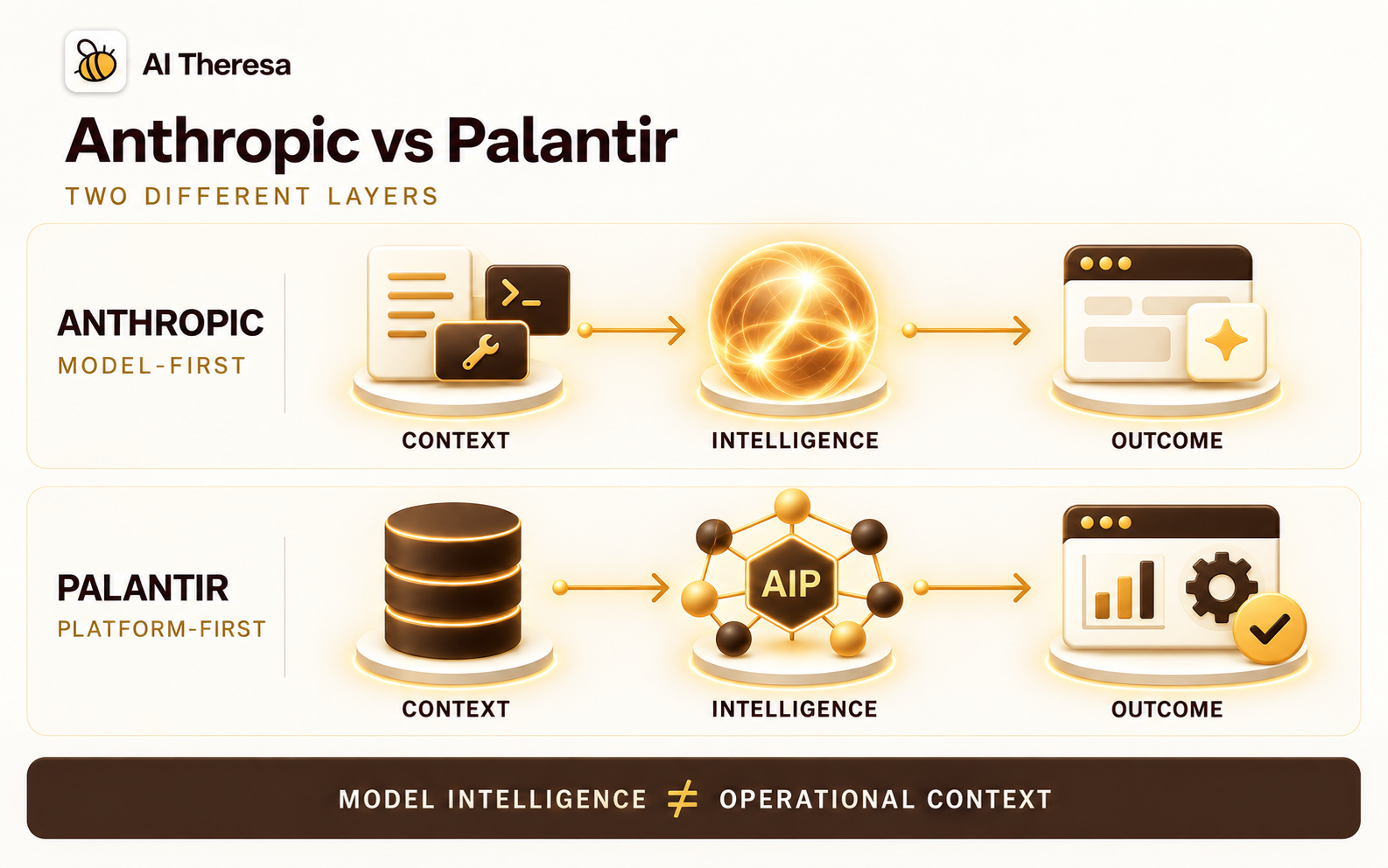
Anthropic and Palantir are often compared because both appear in enterprise AI programs. Technically, however, they operate at different layers. Anthropic develops the Claude family of foundation models and the APIs and agent tooling used to build with them. Palantir provides a broader data and operations platform—Foundry, the Ontology, AIP, and Apollo—that connects models to governed enterprise context and business actions.
That distinction changes the buying question. A team building a specialized assistant may need a capable model, tool calling, and a flexible application layer. A team coordinating orders, assets, suppliers, approvals, and operators may first need consistent data, permissions, business objects, and deployment controls. In many architectures, the answer is not Anthropic or Palantir: Palantir documents support for Claude models inside AIP.
This Anthropic vs Palantir comparison covers architecture, AI agents, data integration, security, pricing, deployment, replacement, and coexistence. Product information was checked against official documentation on September 21, 2026. Model availability and prices change, so verify them for your region and contract before purchasing.
Quick takeaway: Choose Anthropic when you need Claude as the intelligence layer for an application. Consider Palantir when you need a governed enterprise data and operations layer around models, applications, and decisions.
What Is Anthropic?
Anthropic is an AI company that develops Claude models and the platform used to access them. The current model family spans different price, latency, and capability profiles. Applications send text, images, and tool definitions to Claude through the Messages API, then receive text or structured tool requests in return. See Anthropic’s model overview and developer platform introduction.
Anthropic offers two main agent-building paths. The Messages API gives developers control over state, client tools, authorization, and tool results. Claude Managed Agents adds a configurable harness for longer-running, asynchronous work. Neither removes the need to define permissions, success criteria, and failure handling.
For tool use, a developer supplies a name, description, and input schema. Claude produces a tool request; the application validates and performs it, then returns the result. Anthropic also supports the open Model Context Protocol (MCP) for connecting models to approved context and tools. Read the tool-use documentation before allowing writes.
Claude Enterprise adds organizational controls such as single sign-on, role-based access, audit logs, SCIM, configurable retention, and a Compliance API. It is an enterprise workspace and coding environment—not a replacement for every data warehouse, system of record, or business application. Anthropic’s Enterprise plan documentation describes the current controls.
Claude uses hosted inference rather than customer-managed model weights. It is available through Anthropic’s API and supported cloud platforms. Models, regions, features, and data handling vary by route.
What Is Palantir?
Palantir is an enterprise data, application, and operations platform. Foundry integrates and transforms data. The Ontology maps that data into business objects—such as customers, orders, equipment, or suppliers—along with properties, relationships, actions, and functions. Applications can then use the same governed definitions instead of recreating them for each workflow. See Palantir’s Ontology overview.
AIP connects large language models to that operational layer. It provides model access, context, agent and automation tooling, evaluation, and developer interfaces. A model might summarize a maintenance record, but the Ontology determines which asset the record belongs to, who can see it, and which approved action can update its state. Palantir’s AIP architecture documentation explains these layers.
Palantir is model-flexible. Its supported-model catalog includes model families from several providers, including Anthropic. Availability depends on enrollment, geography, and deployment. This makes Palantir the surrounding platform, not the underlying foundation model.
Apollo supports delivery across cloud, on-premises, and disconnected environments. That does not make every external model available everywhere; teams must confirm network paths, regional support, accreditation boundaries, and updates. See the Apollo introduction.
Anthropic vs Palantir: At a Glance
| Dimension | Anthropic | Palantir Foundry + AIP |
|---|---|---|
| Primary layer | Foundation models and agent development | Enterprise data, Ontology, applications, and AI operations |
| Core product | Claude models, API, Managed Agents, Claude Enterprise | Foundry, Ontology, AIP, and Apollo |
| Data approach | Application supplies prompts, files, retrieval, and tool results | Integrates enterprise assets into governed, reusable objects and relationships |
| AI agents | Developer-controlled loops or managed agent runtime | Agents and logic grounded in Ontology context and platform permissions |
| Tool execution | Client and server tools; MCP support | Functions, actions, APIs, and agent tools connected to platform context |
| Model choice | Claude family | Multiple supported model providers, including Anthropic |
| Security focus | Model/API and workspace controls | Data, object, application, model, and operational authorization |
| Deployment | Anthropic API and supported cloud platforms | Cloud, on-premises, and disconnected platform deployments |
| Pricing | Published token rates; enterprise plans quoted | Contract-specific platform and compute pricing |
| Best fit | Building an AI product or adding model intelligence | Coordinating data-rich operational decisions across teams and systems |
The shortest explanation is model-first versus platform-first. Anthropic helps an application reason over the context and tools it receives. Palantir helps an organization assemble, govern, and operationalize that context across many applications.
How Anthropic and Palantir Differ
Model intelligence versus operational context
Claude is a probabilistic model. It interprets instructions, analyzes supplied material, produces content, and selects tools. It does not automatically know the organization’s current inventory, access policy, customer hierarchy, or whether an external transaction committed. The application must supply that context and verify the outcome.
Palantir focuses on assembling that operational context. The Ontology represents entities and relationships, while permissions and actions constrain how users and applications interact with them. AIP can then place a selected model inside that governed environment.
For an order delay, Claude can read policy, summarize supplier notes, and propose a response. Palantir can relate the order to inventory, capacity, customer priority, and approved actions. A complete solution may use Claude for interpretation and Palantir for context and controlled execution.
Application state and responsibility
With the Anthropic API, the customer’s application owns state, retrieval, identity mapping, tool execution, logging, and transaction recovery. Developers can pair Claude with their preferred stack, but they also inherit more architectural responsibility.
Palantir owns more of the surrounding stack. Data lineage, object definitions, application access, model use, and operations can live together. Teams must still model the domain, maintain pipelines, define permissions, and manage releases.
Deployment boundary
Using Claude through a cloud marketplace changes its commercial and infrastructure route; it is not equivalent to installing Claude weights in a disconnected environment.
Palantir Apollo can manage software across cloud, on-premises, and disconnected settings. However, an AIP workflow that calls an externally hosted model still needs an approved and supported connection. Separate where the platform runs from where model inference runs when reviewing an architecture.
Anthropic vs Palantir: Core Features
Anthropic capabilities
- Claude model family: Multiple capability and cost tiers for reasoning, coding, visual understanding, and tool use.
- Messages API: A stateless interface for custom applications and agent loops.
- Tool use: Schema-defined client tools plus supported server tools.
- Managed Agents: A hosted harness for long-running agent work.
- MCP support: A standard interface for connecting approved tools and context.
- Enterprise workspace: Administrative, identity, audit, and retention controls for Claude users.
- Cloud availability: Access through Anthropic and supported cloud platforms.
Claude is composable: a team can add it to an existing product without adopting a full data platform. But the model does not supply durable business state. Production systems must validate tools, authorize actions, make retries idempotent, and record downstream results.
Palantir capabilities
- Data integration: Pipelines and interfaces for enterprise sources.
- Ontology: Reusable objects, properties, links, actions, and functions.
- AIP model access: Governed access to supported models from multiple providers.
- Agent and logic tooling: Context-aware workflows that can call functions and actions.
- Operational applications: Interfaces built on shared business objects and rules.
- Evaluation: Test cases and evaluation functions for comparing AI behavior.
- Apollo: Release and deployment management across varied environments.
Palantir’s advantage is shared context. Objects and actions can be reused with consistent semantics and permissions. An Ontology is only useful when identifiers, relationships, policies, owners, and update paths are correctly defined.
Pricing
Anthropic publishes usage prices per million tokens. At the time of review, the Claude model documentation listed:
| Claude model | Input | Output | Context window |
|---|---|---|---|
| Fable 5.1 | $10 / MTok | $50 / MTok | 1M tokens |
| Opus 5 | $5 / MTok | $25 / MTok | 1M tokens |
| Sonnet 5 | $2 / MTok | $10 / MTok | 1M tokens |
| Haiku 4.5 | $1 / MTok | $5 / MTok | 200K tokens |
These are base model rates, not complete application cost. Caching, batch processing, regional endpoints, tools, and managed-agent runtime can change the bill. Claude Enterprise uses sales-assisted pricing. Check Anthropic’s pricing page for current terms.
Palantir does not publish a universal annual platform price. Commercial terms depend on the deployment and contract. AIP translates model usage into compute consumption, and rates can vary by model and region; the documentation warns that displayed rates do not apply to every agreement. See AIP compute usage.
Compare total cost, not token cost alone:
total operating cost = platform + model usage + data work + application engineering + controls + support
For agents, measure cost per accepted outcome. A cheap run that uses stale data or fails after an unconfirmed write is not cheaper operationally.
Security and governance
Anthropic secures the model service and supplies enterprise administrative controls; the customer remains responsible for application authorization and tool execution. Keep retrieved context scoped to the caller, minimize sensitive fields, treat model output as untrusted input, and authorize the resulting action separately. Review Anthropic’s security and compliance information for current commitments and evidence paths.
Palantir applies controls across integrated data, Ontology resources, applications, and model workflows. That broader control plane can reduce duplicated policy logic, but only when permissions are correctly configured. Palantir’s security overview describes the platform approach.
For either option, test denied access across restricted records, relationships, tool arguments, exports, logs, and cached context. Verify deletion, retention, incident review, and regional boundaries.
Anthropic vs Palantir: Pros and Cons
| Product | Advantages | Watchouts |
|---|---|---|
| Anthropic | Direct access to Claude; published model pricing; flexible APIs and tool use; multiple model tiers; works with a team’s chosen application stack | Customer must build or integrate data, identity, state, authorization, observability, and transaction handling; hosted inference limits fully disconnected use; model versions require migration planning |
| Palantir | Integrated enterprise data and operational model; reusable permissions and actions; multi-model AIP; evaluation and application tooling; broad platform deployment options | Requires domain modeling and platform ownership; pricing is contract-specific; can be excessive for a narrow assistant; external model availability still varies by region and environment |
Neither list is a universal ranking. A strong foundation model does not repair inconsistent source data. A broad platform does not guarantee a well-designed agent. Evaluate both against the same representative tasks, permission boundaries, latency targets, and failure cases.
Can Anthropic Replace Palantir?
Not as a drop-in replacement for Palantir’s full data and operations layer. Anthropic can replace the model component of an AI application or power a new application that makes a broader platform unnecessary for a limited use case. It does not natively reproduce Foundry pipelines, an enterprise Ontology, operational applications, or Apollo deployment management.
A small team may not need those layers. A document assistant connected to a few stable APIs may be adequately served by Claude plus an application database, retrieval, identity, and observability. That is an architecture decision, not product equivalence.
Before replacing a Palantir workload, inventory what Palantir currently owns:
- Data ingestion, transformations, lineage, and quality checks.
- Object identifiers, relationships, business rules, and actions.
- Row-, object-, and function-level permissions.
- Applications, approvals, schedules, and downstream writes.
- Evaluation, monitoring, release, audit, and recovery procedures.
If the proposed Claude application does not reproduce or deliberately retire each required responsibility, it is not a complete replacement. Run both systems on versioned test data before switching traffic, and reconcile every write against the system of record.
Can Palantir Replace Anthropic?
Palantir can replace Claude’s role in a specific Palantir workflow by routing to another supported model. It cannot replace Anthropic as a foundation-model developer with an equivalent Palantir-created general-purpose model family.
This distinction matters during procurement. Buying AIP gives access to a governed model layer, not unlimited or automatic access to every model. Administrators select from supported model families, and availability varies by region and enrollment. See Palantir’s supported LLM documentation.
Changing a model is not a simple endpoint swap. Re-evaluate instruction following, tool selection, structured output, latency, safety, and cost. Tokenizers, context limits, tool formats, and refusals differ. Pin model identifiers and maintain migration tests.
If a team primarily needs Claude for products outside Palantir, direct Anthropic or cloud-platform access may remain the cleaner interface. If all model calls live inside governed Palantir applications, AIP can centralize routing, controls, and usage tracking.
Can Anthropic and Palantir Work Together?
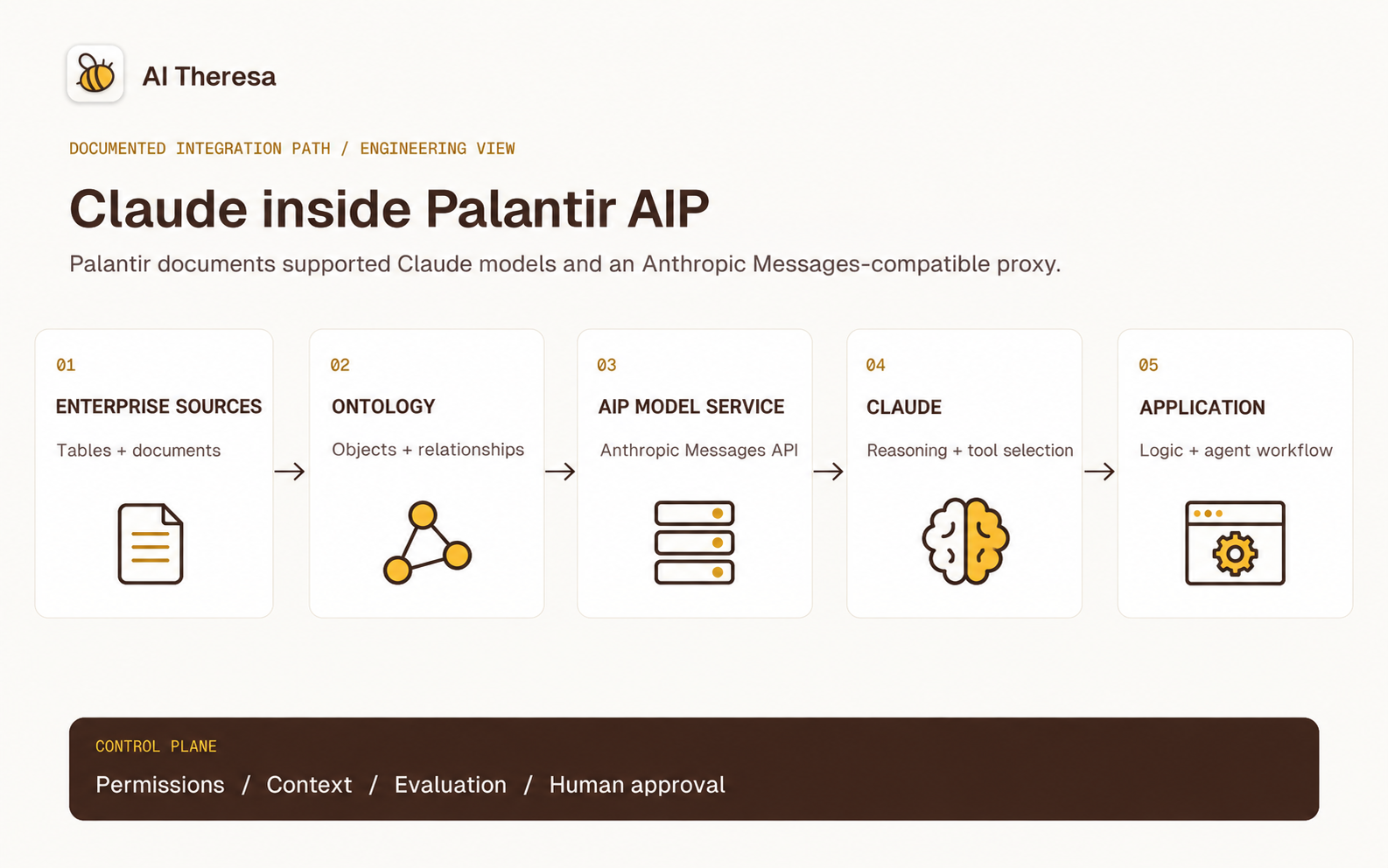
Yes. This is a documented integration pattern, not merely a theoretical custom connector. Palantir lists Anthropic models among its supported LLMs and provides an Anthropic Messages-compatible proxy. AIP can govern the request while Claude supplies model reasoning and tool selection.
A production flow can follow these stages:
- Integrate sources. Connect approved tables, documents, and operational systems to Foundry.
- Model the domain. Define stable objects, links, actions, and permission boundaries in the Ontology.
- Enable the model. An administrator enrolls a supported Claude model for the applicable environment and region.
- Build the workflow. AIP Logic, an agent, or a custom application sends scoped context and tool definitions.
- Execute safely. The platform or downstream service rechecks authorization and validates every action.
- Evaluate and monitor. Version prompts and models, test representative cases, and record model and tool outcomes separately.
Palantir documents a proxy endpoint compatible with Anthropic’s Messages API: /api/v2/llm/proxy/anthropic/v1/messages. This can reduce adaptation for applications already written around the Anthropic message format. It does not make every Anthropic feature identical or available. Authentication differs, SDK configuration may require bearer credentials, and supported parameters depend on Palantir’s implementation. Review the LLM provider-compatible API documentation before migrating code.
Keep the boundary observable. Log identity, model and prompt versions, retrieved objects, tool request, approval, downstream response, and outcome. Avoid sensitive prompt contents when metadata is enough. For writes, use an idempotency key and distinguish “model requested,” “application accepted,” and “system committed.”
Evaluate business behavior rather than one vendor’s wording. Claude may fit one workflow while another supported model better meets a different cost, latency, language, or deployment requirement.
Conclusion
The most useful answer to Anthropic vs Palantir is architectural. Anthropic provides Claude models and agent-building interfaces. Palantir provides a governed enterprise data and operations layer that can use Claude and other models. They overlap in agent tooling, but they are not direct substitutes.
Choose Anthropic when the main requirement is model capability inside an application stack you already control. Consider Palantir when the harder problem is integrating data, defining reusable business objects, enforcing operational permissions, and deploying AI across interdependent workflows. Use them together when Claude’s reasoning should operate on Palantir-governed context and actions.
Validate the decision with one real workflow. Measure accepted outcomes, denied-access behavior, end-to-end latency, recovery after partial failure, and total operating cost. The best architecture is the smallest one that can produce a verified result safely.
For a broader platform shortlist, read our Palantir alternatives comparison. To see how a focused agent platform approaches enterprise workflows, explore AI Theresa.