An employee types, “My laptop keeps shutting down, and I need a replacement before Monday.” A chatbot might explain the equipment policy, gather the required details, or start a replacement workflow. An agent could investigate eligibility, check stock, and work through the steps needed to prepare an order.
Both experiences may begin in the same chat window. The difference is what happens behind it.
When comparing an AI agent vs chatbot, look beyond the quality of the conversation. Examine who chooses the steps, what actions the system can perform, and how it confirms the work is complete.
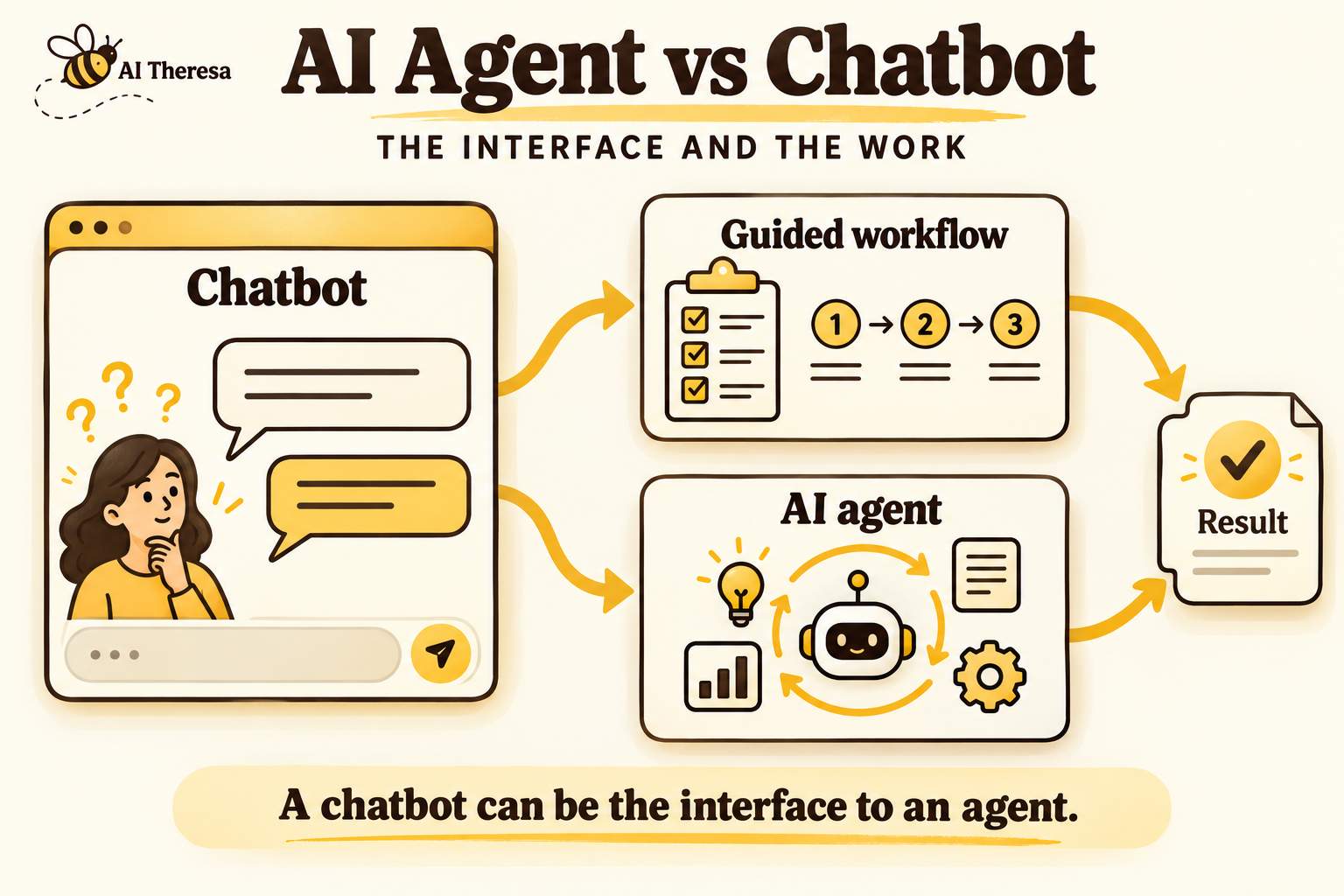
Quick takeaway: A chatbot provides a conversational way to interact with software. An AI agent selects actions toward a goal and can adjust its approach using results. They can overlap: a chatbot may connect to an agent, and both can use business tools.
What Is an AI Chatbot?
An AI chatbot is software that uses AI to interpret conversational input and produce responses through text or voice. It may answer questions, retrieve information, or guide a user through a process.
Traditional scripted bots follow menus, rules, or decision trees. AI chatbots can recognize different ways of asking the same question, and generative systems can compose responses from supplied context. IBM’s chatbot overview describes both approaches and their use of business integrations.
A chatbot is not necessarily a disconnected question-answering tool. It can retrieve an authenticated customer’s order, collect appointment preferences, or trigger a transaction through an API. Those capabilities depend on the application behind the conversation.
For a knowledge assistant, the process might be straightforward: identify the question, retrieve relevant policy passages, and produce an answer with source links. The user remains in control of what happens next.
Conversation quality still matters. The bot needs to recognize missing information, avoid presenting guesses as facts, and offer a useful route to a person when it cannot help.
Get Started with Theresa for FREEWhat Is an AI Agent?
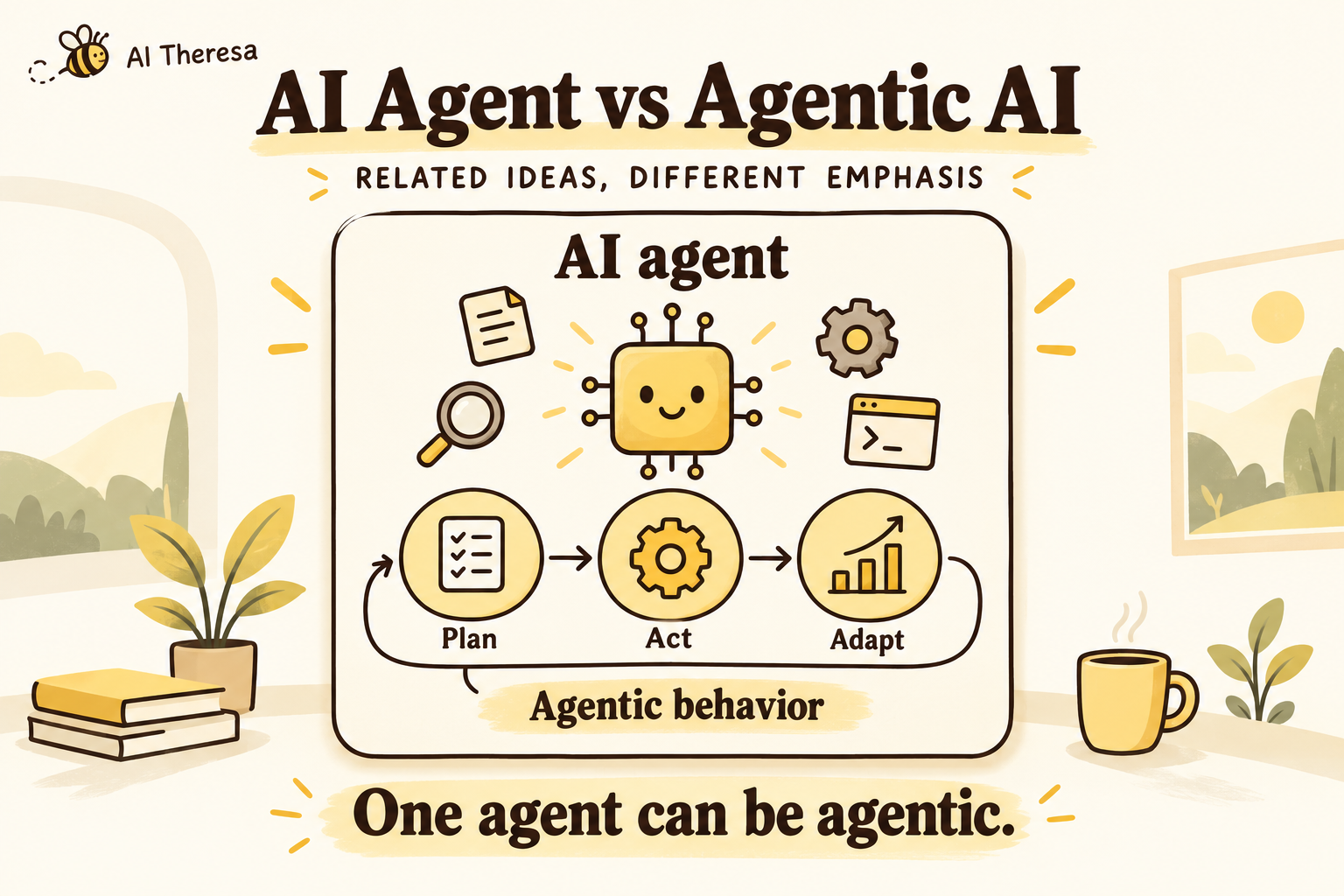
An AI agent is a system that observes information and selects actions to pursue a goal. In many business implementations, a language model helps interpret the situation and choose the next tool or step.
An agent investigating the laptop request might check the device record, discover an active warranty, and change its recommendation from replacement to repair. Its next action depends on what it learns.
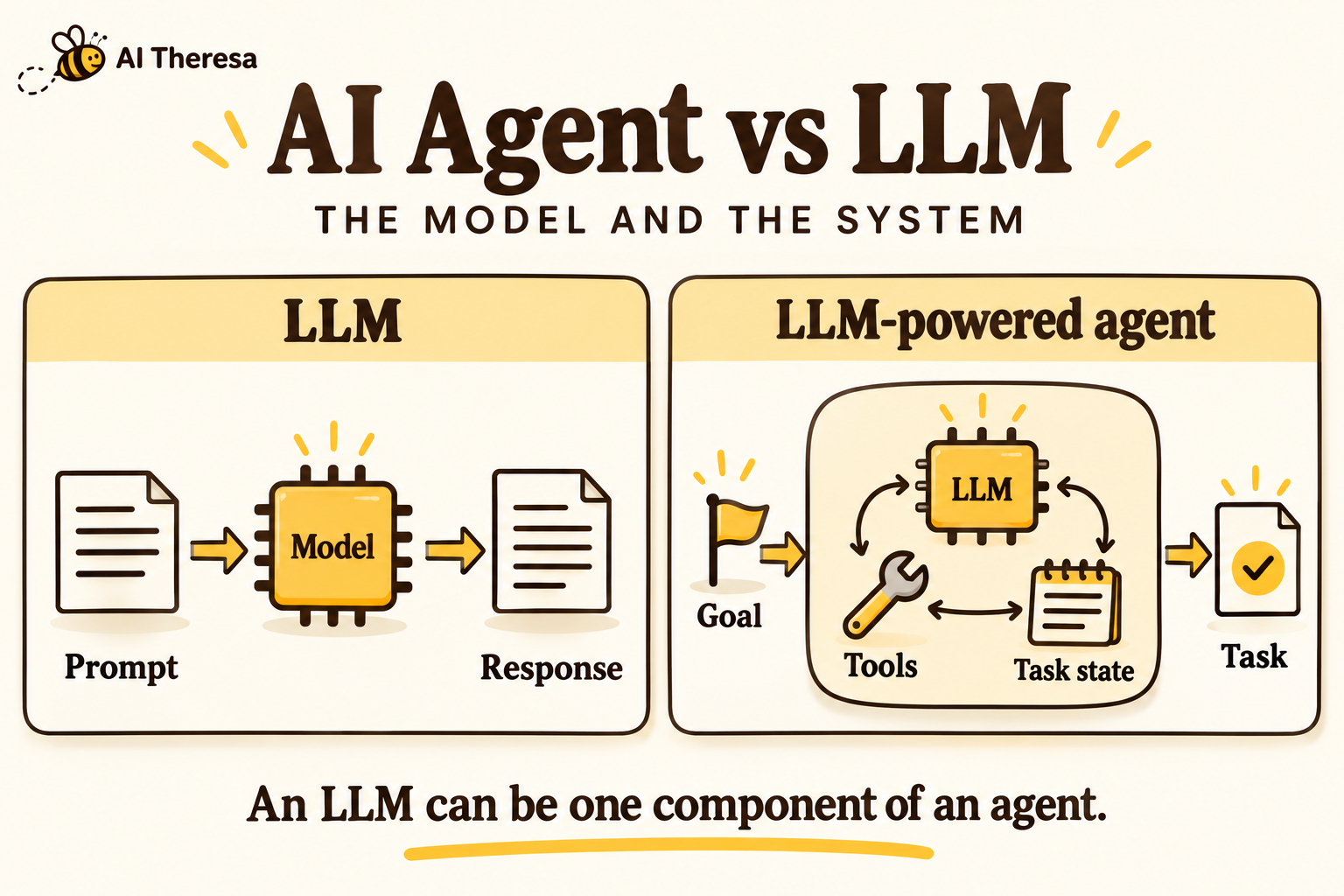
The model does not do all of this alone. Supporting software supplies tools, stores task progress, enforces permissions, and executes approved actions. The agent may operate through chat, a work queue, or an event such as a newly opened support ticket.
Agent terminology varies. For this comparison, the useful distinction is adaptive task execution: the system has some discretion over the path. Anthropic’s discussion of workflows and agents separates predetermined code paths from model-directed processes and tool use.
Get Started with Theresa for FREEHow Do AI Agents Differ From Chatbots?
Conversation is an interface; agency concerns control
“Chatbot” tells you how someone interacts with the system. “Agent” tells you something about how work is selected and carried out. These are different dimensions, so a product can be both.
A chatbot that asks for a booking date and calls a scheduling API can complete a transaction through a fixed flow. An agent might investigate several alternatives when the requested date is unavailable. The presence of an API alone does not establish the distinction.
The user may delegate a larger piece of work
In a guided conversation, the user often advances the process by answering the next question. With an agent, the user can delegate an outcome and let the system decide which permitted steps are necessary.
That delegation has boundaries. “Find an available replacement” does not automatically authorize buying it. The application must distinguish investigation from commitment.
Completion requires evidence
An answer may satisfy an informational request. A task that changes another system needs a different completion check: the requested record exists, the update succeeded, or an approval is pending.
Neither interface guarantees accuracy. A chatbot can provide a wrong policy answer; an agent can act on the wrong account. Both require testing, and the tests should reflect the consequences of their actual capabilities.
Get Started with Theresa for FREEAI Agent vs Chatbot: Side-by-Side Comparison
This table contrasts a conventional chatbot implementation with a task-oriented agent. Modern products often combine the two.
| Dimension | Conventional chatbot | Task-oriented AI agent |
|---|---|---|
| Main emphasis | A useful conversational exchange | Progress toward a defined outcome |
| Typical starting point | A user’s message or question | A request, event, or assigned task |
| Step selection | Often a configured dialogue or workflow | Some steps selected dynamically from context |
| Tool access | Can retrieve records and trigger actions | Selects available tools within its permissions |
| Handling variation | Answers, follows configured branches, or hands off | Can investigate and revise the next step |
| State | Conversation and workflow state as implemented | Task progress across actions; persistence requires storage |
| Human involvement | Often guides the flow through conversation | Can approve decisions or intervene at checkpoints |
| Success measure | Correct answer or successful supported transaction | Verified task outcome within the allowed scope |
| Main operating concern | Answer quality and effective escalation | Those concerns plus action correctness and recovery |
Do not assume that chatbots are always inexpensive or agents always complex. A heavily integrated chatbot can require substantial engineering. A narrowly scoped agent may use only a few tools. Compare the specific design and workload.
Get Started with Theresa for FREEHow AI Agents Handle Tasks Beyond Conversations
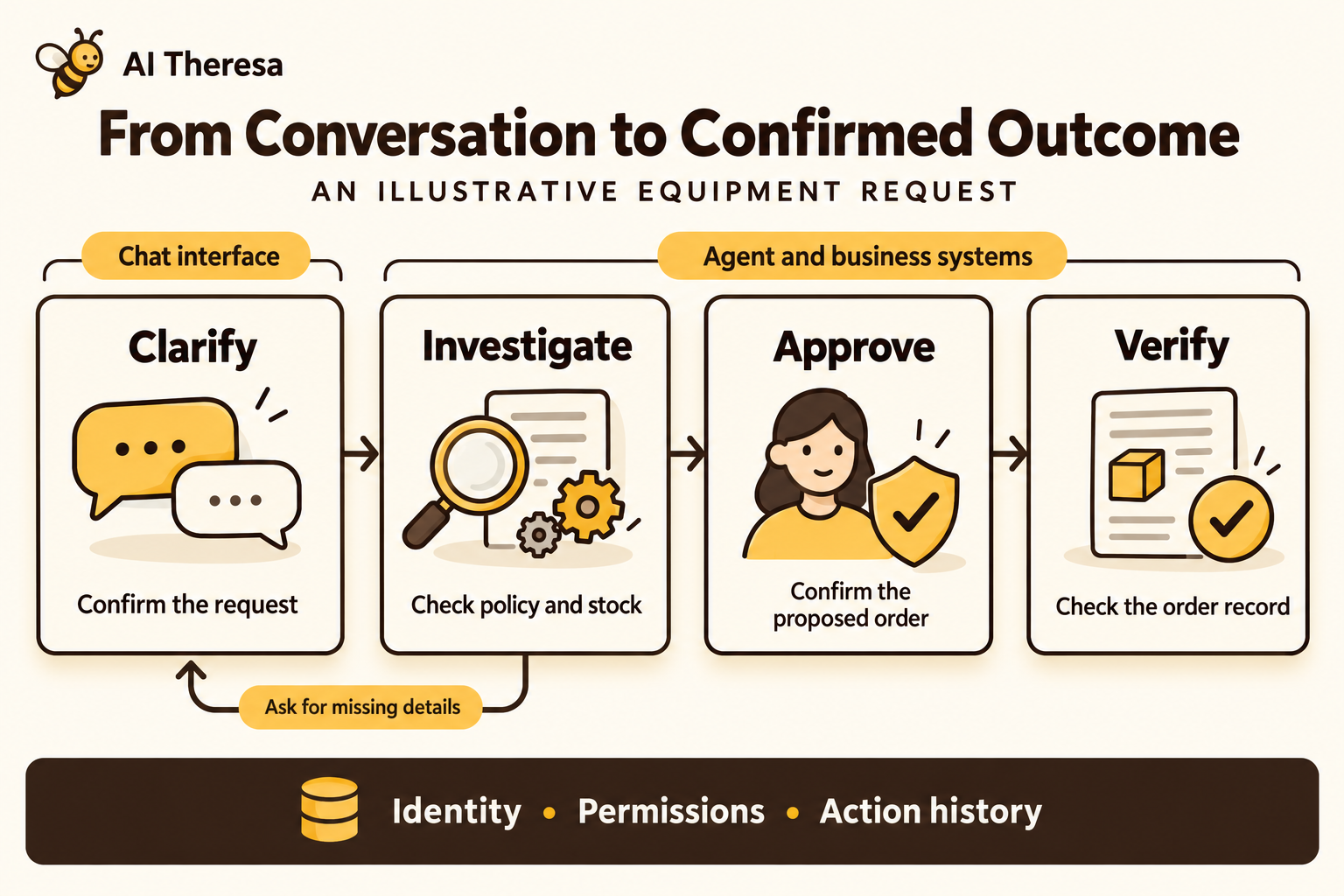
Return to the equipment request. The following is an illustrative workflow, rather than a claim about a particular customer deployment.
The system first identifies the employee and clarifies what they need. The application determines which records the employee is allowed to access; a name typed into chat is not proof of identity.
Next, the agent examines the asset record and relevant policy. A device under warranty might lead to a repair request. A confirmed replacement need could lead to a stock check. Missing information prompts a focused question instead of an unsupported assumption.
The agent then prepares an action with concrete details: the proposed item, delivery address, and any required approval. A manager can review the actual proposal before the ordering tool is called.
After execution, the system checks the order record and reports its status. If the request timed out, it checks whether an order was created before retrying. Otherwise, a temporary connection failure could produce duplicate equipment orders.
The process also needs a stopping point. When inventory is unavailable or a policy exception is required, the useful result may be a documented handoff to purchasing.
For more on connecting model decisions to business tools, see our guide to agentic workflow automation.
Get Started with Theresa for FREEAI Agents vs Chatbots: Real-World Examples
Dialogflow CX: conversation connected to business logic
Google’s Dialogflow CX documentation describes systems that interpret text or audio in conversations. Its webhook documentation explains how those conversations can validate collected information, generate dynamic responses, and trigger backend actions.
This demonstrates why “chatbots only talk” is an unreliable comparison. A conversational flow can perform useful work without giving a model broad discretion over the sequence. Google also uses the word “agent” for these conversational applications, another reason to inspect behavior rather than rely on names.
Agentforce: conversations with configured service actions
Salesforce’s Agentforce service examples include order lookups, delivery scheduling, reservations, and escalation. The examples connect customer requests to configured actions and instructions.
The interaction remains conversational, while the supporting system can do more than supply an answer. Actual capabilities depend on the business’s configuration, permissions, and integrations. A demonstration of a successful reservation does not establish that every unusual request can be resolved independently.
GitHub Copilot: moving from questions to delegated work
GitHub documents chat and agentic experiences within the same product. Users can ask about a repository or delegate work to a cloud agent that edits files and runs tests in a development environment.
This is a useful example of coexistence. Explaining a function and implementing a change are different tasks, even when requested in the same conversation. For the latter, reviewing the resulting code and test evidence matters more than the fluency of the final message.
Get Started with Theresa for FREEWhen Should Businesses Use AI Chatbots?
An AI chatbot is a good fit when conversation makes information or a familiar process easier to access. Common candidates include product questions, internal policy guidance, service intake, and status lookups.
It can also work well when users should make the important choices themselves. A customer selecting an appointment time may prefer a short guided exchange to delegating the entire scheduling decision.
Start with content the business can maintain and questions it can answer reliably. If the underlying policy is contradictory, a conversational interface will expose that problem rather than solve it.
Make escalation part of the experience. A handoff should carry the question, relevant context, and steps already attempted so the person taking over does not force the user to start again.
Get Started with Theresa for FREEWhen Should Businesses Use AI Agents?
Consider an agent when the work requires investigation and the next step changes with the findings. Examples include tracing a billing discrepancy, preparing a response to a service exception, or working through a software defect.
The task should have a recognizable completion condition. “Improve operations” is too broad to evaluate; “identify why this request stalled and prepare the next action” gives the system a bounded assignment.
Useful tool access is essential. If the agent cannot inspect the relevant records or verify an update, its final response may only describe what should have happened.
Begin with a limited scope and reviewable outputs. Expand to permitted actions after measuring how the system handles ordinary cases and exceptions. Some decisions may remain with a person indefinitely, especially when context outside the available systems determines the right outcome.
Get Started with Theresa for FREEAdvantages and Limitations of AI Agents and Chatbots
Chatbots can make services easier to navigate
A conversational interface lets people describe a need in their own words. It can reduce searching and collect enough context for the next stage of a process.
Its limits depend on the implementation. A retrieval-based assistant can miss a relevant document or misread a condition. A tightly scripted bot may repeatedly offer options that do not fit. Measure whether people get useful answers and successful handoffs, rather than treating every conversation that avoids a human as a success.
Agents can reduce manual coordination
An agent can gather information across systems and adapt when an expected record is missing. That can reduce the repeated lookups and follow-up questions that occupy employees between formal workflow steps.
The additional discretion creates more to operate. Longer runs need limits, recovery, and an action history. Tool access can increase the consequences of mistakes. OWASP’s excessive-agency guidance identifies risks from excessive functionality, permissions, and autonomy.
Cost comparisons should include inference, integrations, monitoring, and human review. Count failed attempts and correction work too. A system that looks cheap per message may be expensive per resolved case.
Both systems also need rules for handling untrusted content. A retrieved page or customer attachment might contain instructions that conflict with the task. Treat that material as evidence to evaluate, not permission to change the system’s behavior. Keep authentication and authorization in application code, and avoid exposing credentials or unrelated customer records merely because they could help generate a more detailed response.
Get Started with Theresa for FREECan Chatbots and AI Agents Work Together?
Yes. A chatbot can serve as the front door while an agent carries out the investigation behind it.
For example, the chat interface can collect an equipment request, show the agent’s proposed order, and ask the manager to approve it. The agent can query systems and return a result without requiring the user to supervise every lookup.
The handoff must preserve identity and scope. The backend should receive the verified user context and the approved task, not an unrestricted instruction to do whatever the conversation suggests.
Progress should also be visible. If work continues after the user leaves the chat, provide a task identifier and a way to see whether it is running, blocked, or finished. Saving conversation history alone does not provide reliable background execution.
Give users a way to cancel work and correct an earlier instruction. If an order has already been submitted, cancellation may require a separate operation rather than simply ending the conversation. The interface should distinguish actions already completed from proposals still awaiting approval, so the user knows what can still be changed and where approval stands.
A hybrid product can route straightforward requests through fixed flows and use an agent only where investigation adds value. The user should experience one coherent service.
Get Started with Theresa for FREEWill AI Agents Replace Traditional Chatbots?
Some scripted interactions may give way to more flexible systems, but there is no reason to assume that every chatbot needs autonomous planning.
A short menu, policy lookup, or predictable transaction may already meet the user’s need. Replacing it with an agent introduces different testing and operating requirements without necessarily improving the experience.
My expectation is that the boundary will become less visible to users: more conversational products will combine fixed workflows, generative answers, and agent capabilities. That is an architectural judgment, not a guarantee about how quickly the market will change.
For businesses, replacement should follow evidence that the existing experience is failing or leaving valuable work unfinished.
Get Started with Theresa for FREEHow to Choose Between an AI Agent and a Chatbot
Start with actual requests rather than a feature list. Separate informational questions, predictable transactions, and cases that require investigation. Each category may need a different implementation.
Define what success means for each one. For a policy question, check whether the answer is correct and supported. For an account update, inspect the resulting record and confirm that the action was authorized.
Ask vendors to demonstrate difficult cases: missing information, contradictory records, unavailable tools, and requests outside the allowed scope. Watch whether the system asks a useful question, stops appropriately, or confidently claims success without evidence.
Compare the complete operating cost. Include setup, content maintenance, API usage, review time, and failures that employees must repair. Measure response speed where it matters, but also measure the time until the user’s need is actually resolved.
Assign an owner for policy changes and ongoing evaluation. Keep representative cases so a model or integration update can be checked before it changes production behavior.
Our guide to enterprise AI agent deployment covers the infrastructure and controls needed when a successful pilot becomes an operating service.
Get Started with Theresa for FREEFinal conclusion
The choice between an AI agent and a chatbot starts with the work. Conversation may be enough for a clear answer or a guided transaction. Adaptive task execution becomes useful when the system must investigate, choose steps, and verify a result.
Often, the right solution combines both. Keep the interface easy to use, grant only the authority the task needs, and judge the system by whether it reliably helps people finish what they came to do.