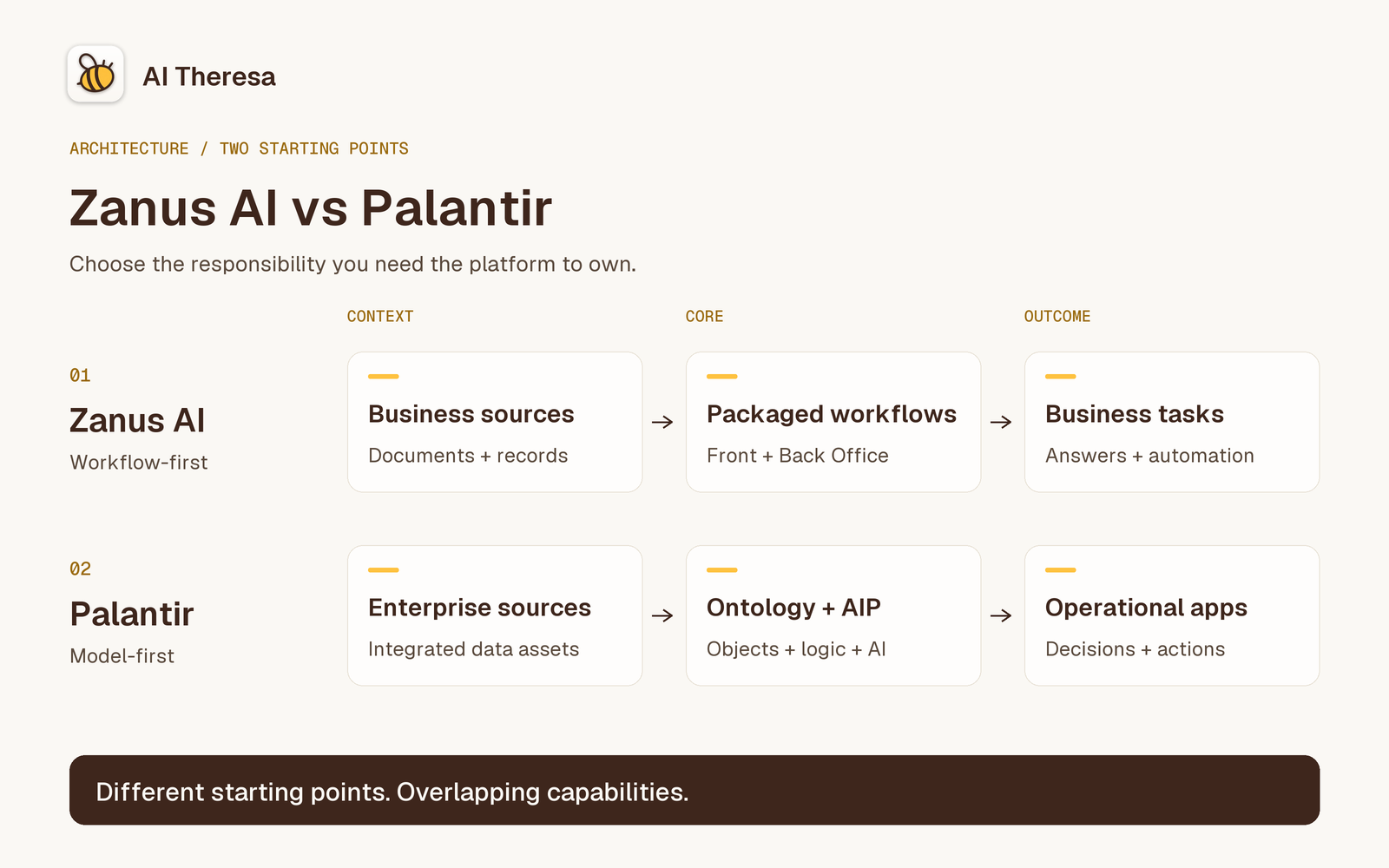
Zanus AI and Palantir both connect AI to business work, but they begin at different layers. Zanus packages customer-facing and internal workflows. Palantir combines enterprise data, an operational Ontology, applications, and AI. The practical choice is therefore not “which chatbot is better?” It is which responsibilities should the platform own?
For a narrow workflow—answering approved product questions, preparing a report, or coordinating bookings—Zanus may reduce custom application work. For decisions that depend on shared objects such as customers, orders, inventory, and suppliers, Palantir offers a broader operational foundation.
This comparison covers agents, data integration, ontology, security, pricing, deployment, replacement, and coexistence. “Palantir” primarily means Foundry and AIP, with Apollo included where deployment matters. Product claims and prices were checked against official pages on September 21, 2026; suggested architectures are engineering recommendations, not promises of native integrations.
Quick takeaway: Choose Zanus for a defined workflow that fits its packaged products. Consider Palantir when many applications need the same governed data and operational model.
What Is Zanus AI?
Zanus AI presents three related offerings:
- Front Office: phone, chat, demos, quotes, bookings, and customer interactions.
- Back Office: documents, tasks, projects, scheduled work, and automation.
- Private AI servers: an ownership and on-premises deployment option.
The distinction matters. A hosted Front Office subscription is not the same purchase as a private server or a Back Office deployment. The Zanus product overview is the starting point for confirming scope.
Back Office emphasizes configured work rather than an empty development environment. Teams can attach documents, schedule tasks, review cited output, and track milestones. That can shorten a pilot when the desired process already resembles a supported workflow. See the Back Office overview.
Integration surfaces vary by product. Front Office lists Salesforce and HubSpot synchronization, webhooks, a read-only API, and scoped Model Context Protocol access. Back Office describes REST interfaces for triggering work and retrieving results. Confirm authentication, rate limits, write behavior, and edition availability for the deployment you are buying. See Front Office connectors and Back Office integrations.
Zanus also describes document-grounded answers. Treat grounding as a design goal that still needs testing. Include missing sources, stale policies, contradictory documents, and requests outside a user’s permissions.
What Is Palantir?
Palantir Foundry connects enterprise data to operational applications. Its central architectural concept is the Ontology: business objects, their properties and relationships, plus the actions and functions that operate on them. It sits above datasets, virtual tables, models, and other integrated assets. Palantir’s Ontology documentation explains this layer.
For example, a delayed order may depend on a customer, inventory, supplier commitments, production capacity, and delivery promises. A document assistant can retrieve a shipping policy. An operational model also represents which inventory belongs to which order and which actions are valid.
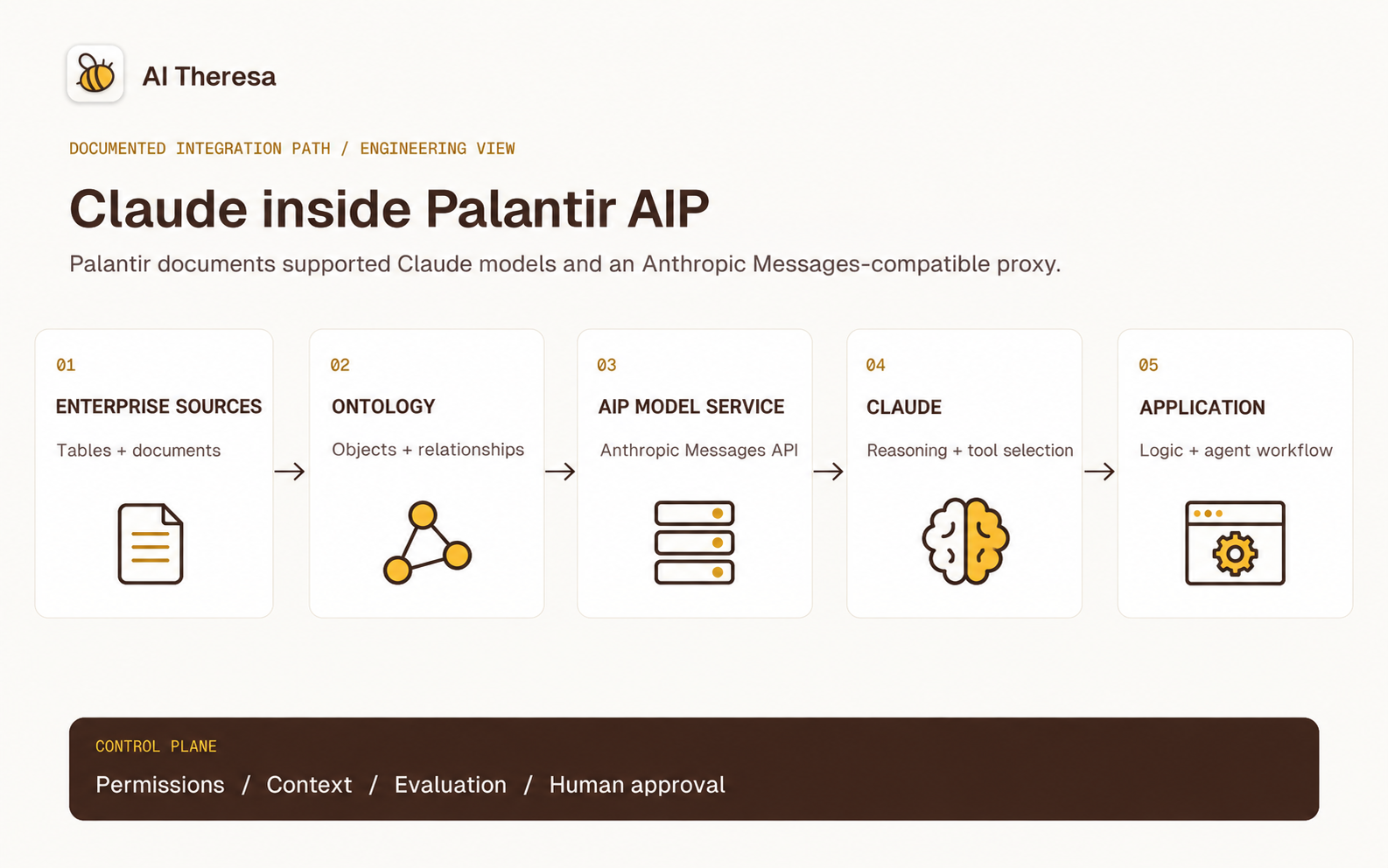
AIP adds AI workflows, assistants, and evaluation around that foundation. Its documented tools include AIP Logic, AIP Chatbot Studio, and AIP Evals. Assistants can use enterprise context and tools through APIs and the Ontology SDK. See the AIP overview and Chatbot Studio documentation.
Apollo supports software deployment and management across cloud, on-premises, and disconnected environments. Specific services still depend on the chosen environment; see Apollo’s deployment overview.
Palantir’s breadth does not remove implementation work. A team must still define identifiers, transformations, permissions, application behavior, and acceptance tests.
Zanus AI vs Palantir: Key Differences
| Dimension | Zanus AI | Palantir Foundry + AIP |
|---|---|---|
| Starting point | Packaged Front Office and Back Office workflows | Integrated data, operational modeling, applications, and AI |
| AI execution | Configured assistants, scheduled work, and automation | AI workflows, functions, and context-aware assistants |
| Data integration | Connectors, APIs, webhooks, and MCP; scope varies by product | Enterprise data integration plus interfaces to existing systems |
| Ontology | Records and document context; no equivalent framework established by the reviewed pages | Explicit objects, properties, links, actions, and functions |
| Customization | Configure supported workflows and integration surfaces | Build domain models, logic, and operational applications |
| Evaluation | Validate grounding and task outcomes in a pilot | AIP Evals supports test cases and version comparisons |
| Deployment | Hosted products and private-server options | Cloud, on-premises, and disconnected options |
| Best fit | A defined workflow that matches the product | Interdependent workflows using shared operational context |
Architecture
The core distinction is workflow-first versus model-first. Zanus begins with a business task and connects the sources needed to complete it. Palantir begins with integrated assets and an Ontology that can support many applications. Capabilities overlap, but the implementation center of gravity differs.
Retrieval is also not the same as ontology modeling. Retrieval supplies relevant evidence to a response. An operational model defines what entities mean, how they relate, and which state changes are valid. A purchasing assistant might quote an approval policy correctly while still misunderstanding whether a specific order was already approved.
Pricing
Zanus publishes these Front Office prices in USD:
| Plan | Annual subscription | One-time onboarding | Startup credits |
|---|---|---|---|
| ANSWER | $4,900 | $990 | 10,000 |
| SELL | $9,900 | $1,990 | 25,000 |
| CLOSE | $19,900 | $2,990 | 75,000 |
| SCALE | From $49,900 | Quoted separately | 250,000 |
The pricing page advertises unlimited users, but AI activity consumes credits. Startup credits are one-time, and refills or extra language packs can add cost. These prices should not be presented as quotes for Back Office or private hardware.
Palantir requires a deployment-specific quote. Its AIP compute documentation describes model-dependent token consumption and compute-second translation, while warning that published rates do not apply to every contract.
For either product, compare three-year cost across subscription or licensing, implementation, usage, infrastructure, support, and change management. A useful shared metric is:
cost per accepted task = total measured operating cost / tasks meeting acceptance criteria
Security
Zanus’s trust page says its SOC 2 Type II examination is underway; that is not the same as a completed report. The page also places Google Workspace and Microsoft Entra ID single sign-on on the SCALE plan. Request current evidence and confirm contractual scope.
Palantir documents granular authentication and authorization controls, but controls still require correct configuration. For both products, test denied access through retrieval, APIs, tools, logs, and exports—not only the visible interface.
When to Consider Zanus AI
Zanus is a strong candidate when the workflow is bounded and resembles its packaged applications. Typical signs include:
- You want to answer from approved product or policy material.
- You need scheduled document work with reviewable output.
- You want a customer-facing workflow without building every interface.
- A hosted or private-server deployment matches your ownership requirements.
- The existing systems of record can remain authoritative.
Run a narrow pilot. Define the approved knowledge, prohibited claims, escalation rules, operating hours, and record owner. Then test an expired price, an unavailable appointment, a restricted request, and a retry after a timeout.
For private deployments, assign owners for hardware, patches, backups, and recovery. Zanus’s Back Office security documentation describes field-level redaction, configurable audit categories, rollback snapshots, and USB updates for air-gapped sites. Validate those controls against your own operating procedures.
The best result is not a polished demo. It is an end-to-end workflow on representative data with manageable exceptions and a named operator.
When to Consider Palantir
Palantir merits consideration when several decisions depend on the same governed business model. Common signals include:
- Multiple applications need consistent customer, order, asset, or supplier definitions.
- Data integration and operational AI belong to one wider platform program.
- Actions require granular permissions and shared business rules.
- Teams need formal evaluation and release management for AI workflows.
- Deployment spans cloud, on-premises, or disconnected environments.
A supply-chain application illustrates the fit: demand, supplier commitments, inventory, production constraints, and customer priority must be related before the system can recommend an action. Reusable objects and actions may matter more than adding another conversational interface.
Palantir’s interoperability documentation describes standard interfaces to analytics, workflow, and security systems. AIP Evals supports test cases, evaluation functions, version comparison, and repeated-run analysis.
Choose a pilot with a real cross-system dependency. Measure freshness, permission enforcement, action completion, and recovery after partial failure. Name the owners of the Ontology, integrations, and application releases before scaling.
Can Zanus AI Replace Palantir?
For a bounded workload, possibly. As a proven drop-in platform replacement, the reviewed evidence does not establish equivalence.
A Zanus workflow may replace a Palantir-backed process that is limited to document questions, report preparation, or a supported customer interaction. Demonstrate the substitution with the same inputs, permissions, and expected outcomes.
A broader migration requires an inventory of:
- Coverage: integrations, transformations, applications, and workflows to reproduce or retire.
- Semantics: business objects, identifiers, relationships, and rules to preserve.
- Control: authorization, approvals, audit, and retention requirements.
- Recovery: duplicate prevention, rollback, reconciliation, and incident ownership.
Run both paths on a controlled dataset before switching production traffic. Track answer correctness, supporting evidence, unauthorized-access attempts, and confirmed state changes separately. Measure end-to-end latency, including retrieval and downstream services, and keep failed runs in the report.
Version the dataset, prompts, rules, and connector configuration. Re-run the same cases after a model or integration changes. For write workflows, include a destination outage after the request is accepted but before confirmation returns; ambiguous outcomes are where duplicates and silent failures appear.
Can Zanus AI and Palantir Work Together?
Yes, through a designed integration. However, this review did not establish a native, vendor-supported Zanus–Palantir connector. API availability makes a custom pattern plausible; it does not prove compatibility for a particular deployment.
One arrangement keeps enterprise modeling and operational decisions in Palantir while Zanus handles a focused business-facing workflow. A separate integration service exchanges narrowly scoped data, maps identifiers, validates requests, and writes audit records.
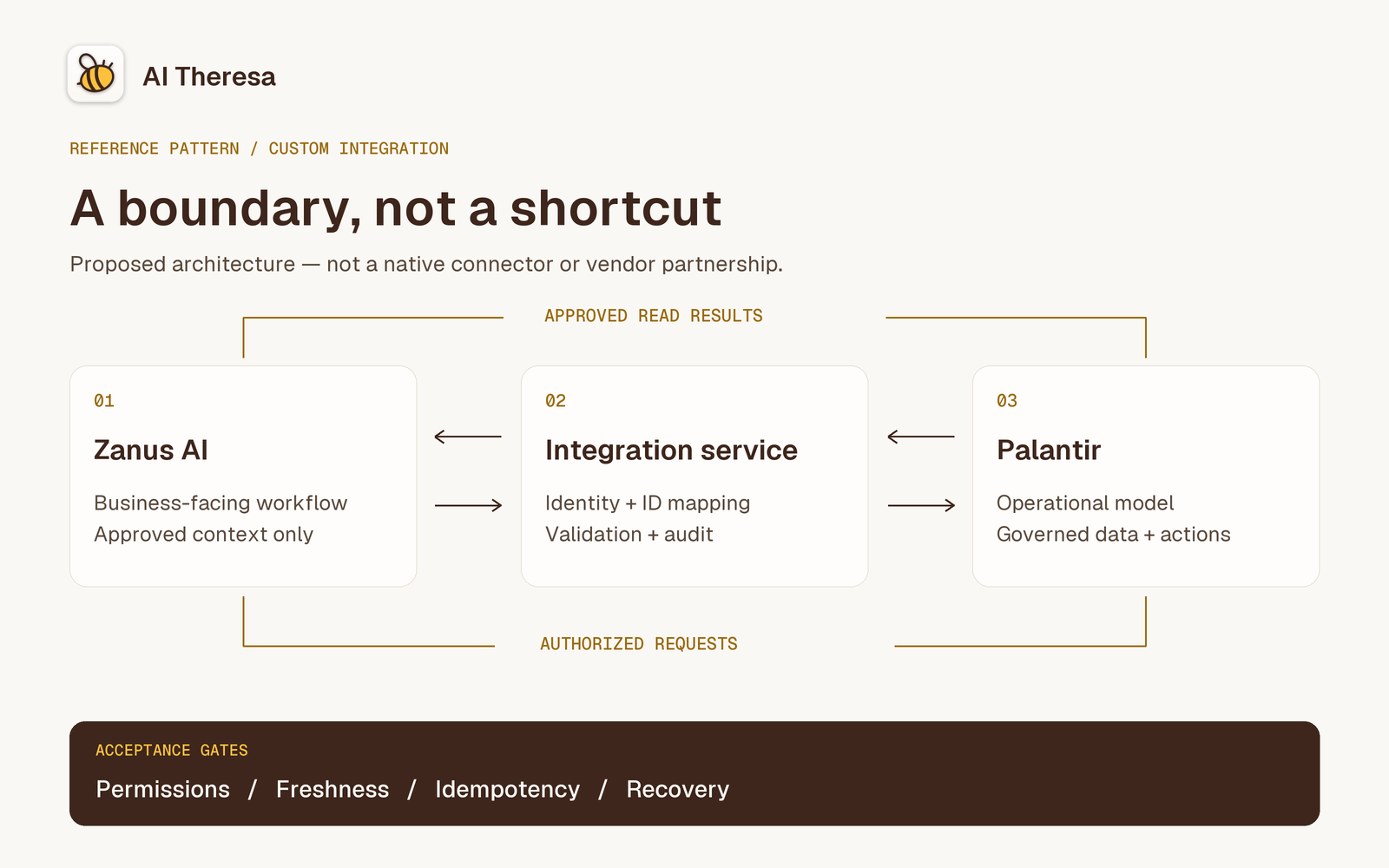
Start read-only. An order-status assistant can use an approved view with stable order identifiers and source timestamps. If freshness requirements fail, return an explicit stale or unavailable result instead of improvising a delivery promise.
Add writes only after defining actor, target record, operation, request ID, approval state, and receiving-system validation. Use idempotency keys for retries and reconcile ambiguous outcomes. A successful assistant response is not proof that a transaction committed.
Finally, confirm deployment compatibility. A disconnected environment cannot participate in a live cloud API exchange without an approved transfer process or a different deployment choice.
Zanus AI vs Palantir: Pros and Cons
| Product | Advantages | Watchouts |
|---|---|---|
| Zanus AI | Packaged workflows can reduce custom development; Front Office publishes prices; hosted and private options; business connectors can preserve systems of record | Credits and onboarding complicate headline cost; public pages do not establish Ontology equivalence; attestations, throughput, and recovery need verification |
| Palantir | Shared operational model; integrated data, applications, AI, and governance; broad deployment options; reusable domain definitions | Requires ownership of models, permissions, integrations, and releases; pricing is contract-specific; a narrow workflow may not justify the wider platform |
Treat these as fit assessments, not universal rankings. The decisive evidence is how each option performs against the same workflow, data, permissions, failure cases, and acceptance criteria.
Conclusion
The practical difference between Zanus AI and Palantir is the starting point. Zanus packages business workflows. Palantir provides a broader data and operational foundation on which teams can build many workflows and applications.
Choose one representative process, define its data and permission boundaries, and measure the complete path from request to verified outcome. That evidence will tell you whether to adopt a focused product, retain a wider platform, replace one workload, or connect both through a controlled boundary.
For a broader shortlist, read our Palantir alternatives comparison. If the workflow itself is still unclear, explore AI Theresa before choosing the technology.