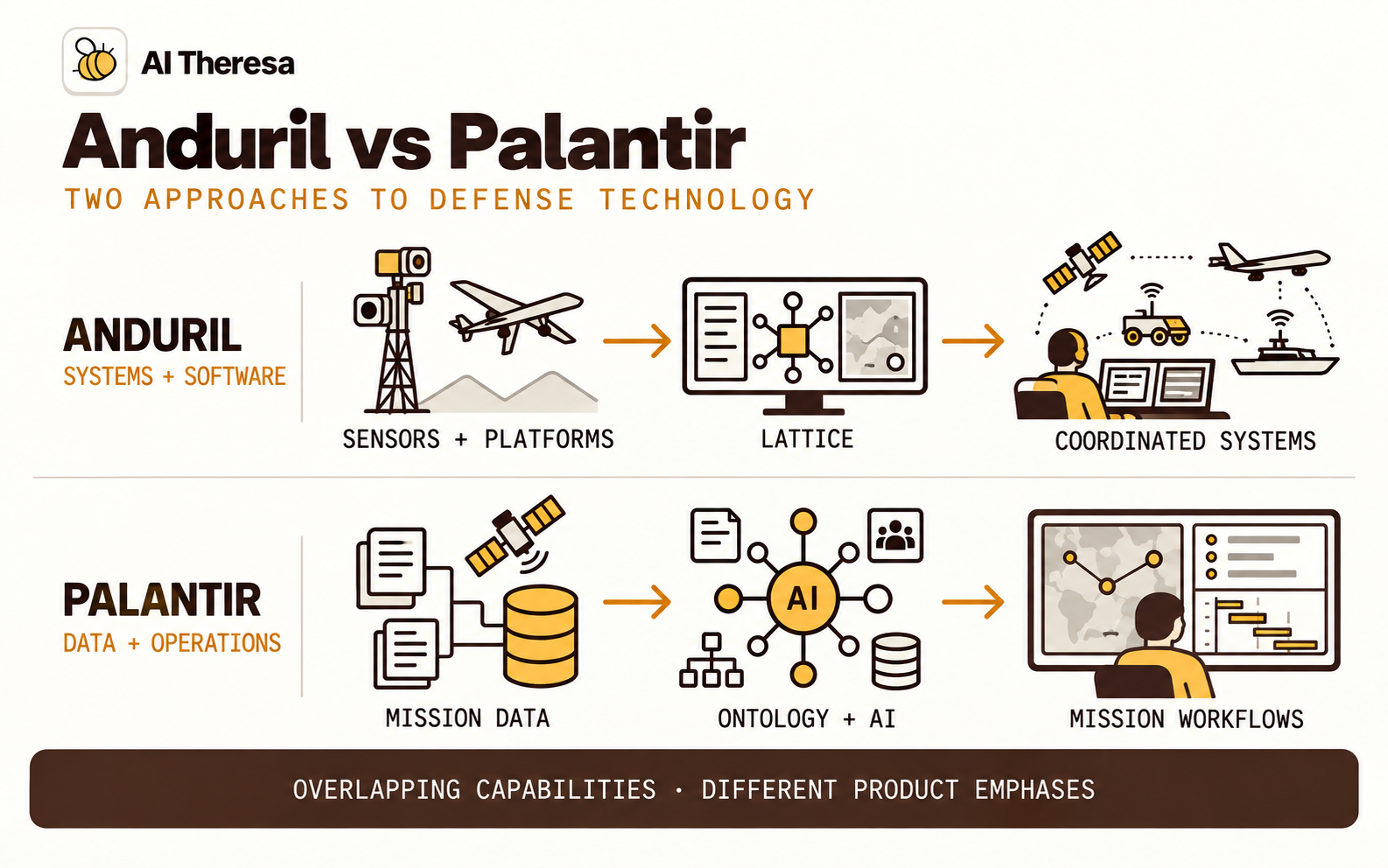
Anduril and Palantir are often discussed together because both sell technology to defense organizations and both make AI part of their offering. But they approach the work from different directions. Anduril builds physical defense systems and the software that connects them. Palantir builds software for bringing information together and helping people use it in analysis, planning, and operations.
Calling this a hardware-versus-software comparison leaves too much out. Anduril's Lattice is a software platform in its own right, including integrations with other manufacturers' systems. Palantir's defense applications extend from analysis into planning and operational coordination. The companies overlap in some areas, and they also work together.
The differences become clearer when you look at what a customer needs to buy, connect, and maintain. We'll compare Lattice with Gotham, explain how each company uses AI, and examine what their business models mean for a deployment. Product details draw on official documentation and announcements reviewed on September 28, 2026.
Quick takeaway: Anduril combines physical defense products with software for connected systems and mission autonomy. Palantir provides data, AI, and operational software for defense and commercial organizations. Their offerings can overlap, compete, or work together depending on the program.
What Is Anduril?
Anduril Industries develops defense equipment, autonomous systems, and the software used to connect them. Its product portfolio spans air and underwater systems, surveillance, counter-drone capabilities, and deployable computing. An Anduril contract can therefore involve manufacturing and delivering equipment as well as writing and maintaining software.
Lattice brings those systems together for operators. Its command-and-control capabilities help people understand a situation and coordinate resources. Its mission-autonomy capabilities concern how autonomous equipment carries out work under human supervision. These functions are related, but connecting a sensor to an operator's display is a different task from coordinating autonomous platforms.
Anduril also develops individual platforms. Its Fury product page, for example, describes an autonomous aircraft designed around modular systems, software development, and testing. The aircraft has to work with its onboard software and the operator's tools. That gives a systems supplier responsibilities that go well beyond delivering a standalone application.
Lattice extends beyond Anduril hardware
Lattice can integrate third-party and government-owned capabilities. Anduril's developer documentation describes applications for functions such as situational awareness, planning, and tasking, together with interfaces for connecting systems. Buying Anduril hardware and developing a Lattice integration are consequently different project scopes.
An organization with equipment from several manufacturers may want to connect what it already owns. In that case, the relevant question is which of those systems Lattice can work with and how much integration is required. Buying a new fleet is a separate decision.
A systems supplier as well as a software supplier
An Anduril deployment can involve equipment delivery, software integration, operator training, maintenance, and ongoing support. The balance depends on the program. A sensor installation has different acceptance criteria from a software integration or an autonomous aircraft development effort.
The contract needs to make those responsibilities clear. If a third-party sensor stops sending updates, for example, who investigates: Anduril, the sensor manufacturer, or the customer's integration team? Resolving that question before deployment is easier than discovering a gap in support after the equipment is in use.
Get Started with Theresa for FREEWhat Is Palantir?
Palantir develops software platforms used by government and commercial organizations to work with complex information and operational processes. In defense, its applications support intelligence analysis, mission planning, situational awareness, and coordination. In commercial settings, the same broader platform approach supports domains such as manufacturing and supply-chain operations.
Four product names are especially relevant:
- Gotham: Defense and intelligence applications for working with mission information and operational context.
- Foundry: Data integration, transformation, logic, Ontology development, analytics, and application building.
- AIP: Capabilities for bringing generative AI, agents, and automation into governed operational workflows.
- Apollo: Software deployment and management across different computing environments.
The products share underlying services. Palantir's platform architecture documentation places its defense offerings within the shared AIP, Foundry, and Apollo architecture. That includes Gotham applications powered by a Foundry-managed Ontology, so the product names should not be read as four isolated systems.
Gotham connects information to mission work
Gotham's user experience includes ways to explore relationships, geographic information, events, and changing operational conditions. Palantir's Gotham operations paper describes planning, a shared operational picture, and reviewing the history of operations.
Putting records in one place is only the beginning. Two reports might describe the same event with different identifiers. A location may have several names. An equipment record may be current in one system and outdated in another. Users need to understand those differences and trace information back to its source.
Foundry and AIP supply reusable capabilities
The Palantir Ontology represents entities through objects, properties, links, actions, and functions. It allows applications to share operational definitions rather than rebuilding them independently. AIP adds model access and tooling around that context.
Consider a maintenance planner deciding whether to move a repair forward. The application could show the equipment's condition, available parts, and maintenance history together. An AI assistant might help summarize the records, while the planner reviews and approves a schedule change. Each step depends on current data and the right permissions.
Get Started with Theresa for FREEAnduril vs Palantir: Key Differences
| Dimension | Anduril | Palantir |
|---|---|---|
| Product emphasis | Defense hardware, connected systems, and autonomy software | Data, AI, intelligence, and operational software |
| Relevant platforms | Lattice, including command and control and mission autonomy | Gotham, Foundry, AIP, and Apollo |
| Physical products | Develops sensors, autonomous platforms, and deployable computing | Primarily supplies software integrated with customer and partner infrastructure |
| Typical users | Operators, system integrators, autonomy teams, and defense program teams | Analysts, planners, operators, data engineers, and application builders |
| Data emphasis | Observations, equipment state, and information exchanged among connected systems | Multimodal information, relationships, organizational context, and decision history |
| AI emphasis | Perception, sensor fusion, and software supporting autonomous systems | Analysis, model integration, AI-assisted applications, agents, and operational workflows |
| Integration approach | Lattice interfaces, common data models, and third-party system integration | Source connections, Ontology mappings, application interfaces, and platform APIs |
| Deployment emphasis | Fielded systems and distributed computing, with local processing | Enterprise and deployed software environments, including disconnected configurations |
| Delivery requirements | May combine manufacturing, installation, integration, and sustainment | Typically centers on software deployment, data integration, and workflow implementation |
| Commercial scope | Hardware programs, software capabilities, integration, and support | Platform agreements, applications, implementation, and applicable usage terms |
| Best evaluation starting point | The connected equipment and operator capability required | The information, decision process, and application capability required |
| Relationship between vendors | Can collaborate with Palantir on defined programs | Can collaborate with Anduril on defined programs |
Anduril Lattice vs Palantir Gotham
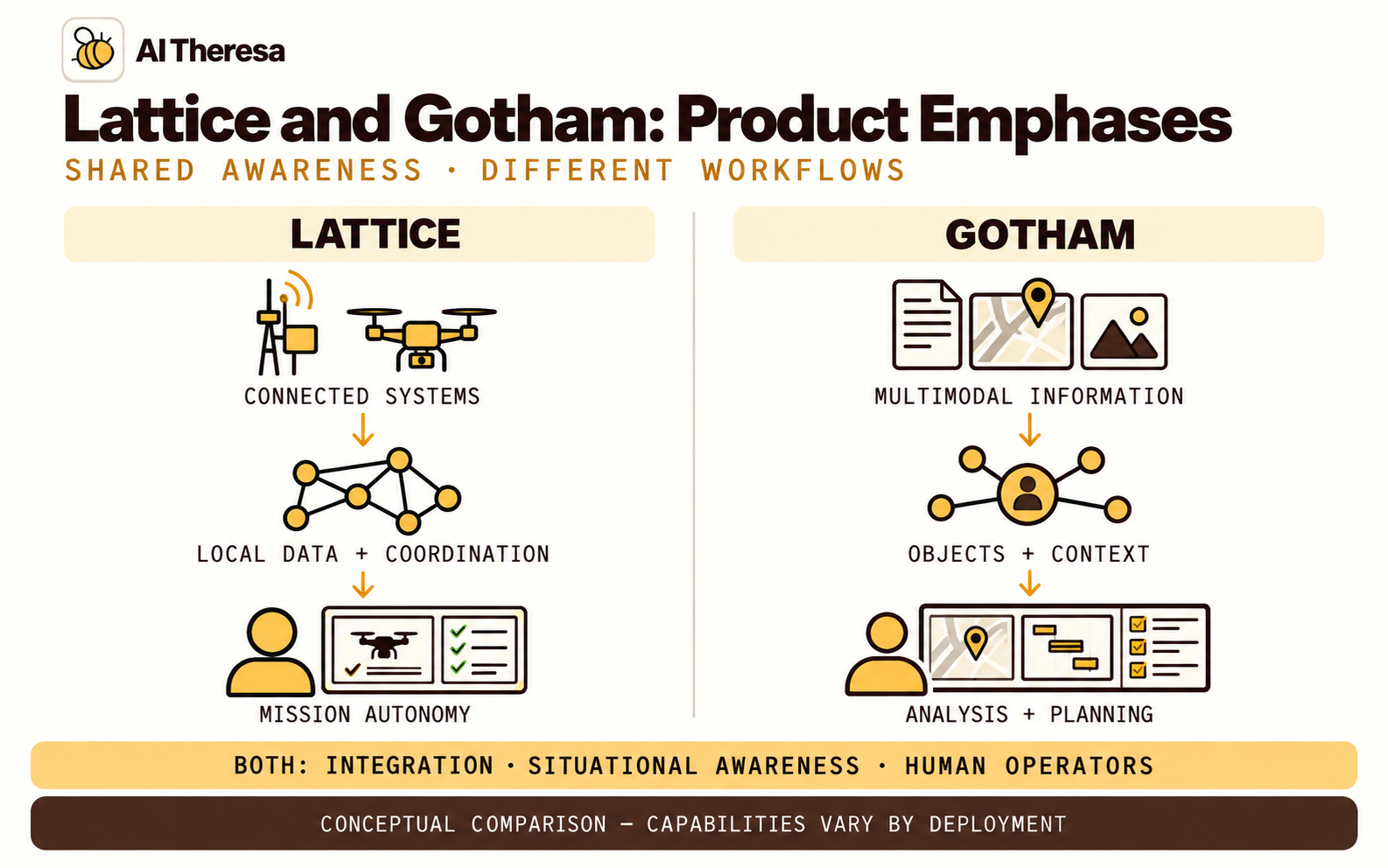
Lattice and Gotham overlap in situational awareness and coordination. Their differences become clearer when you look at how they handle connected equipment and information.
Lattice: connected systems and local processing
Anduril's Lattice development principles emphasize a local-first architecture that accounts for intermittent connectivity. The documentation describes standardized models for entities, tasks, binary objects, and video. These interfaces help different applications and systems exchange information in a common form.
When a connection drops, local processing can keep some functions available without a central service. But different parts of an application may behave differently: locally collected information might keep updating while a remote feed goes stale. Reconnecting also raises the question of how those records are brought back into agreement.
A demonstration should show that transition, including what the operator sees before, during, and after a loss of connectivity. Ask which functions continue locally and which need another service. The answers depend on the sensors, applications, and configuration being proposed.
Gotham: multimodal context and operational applications
Gotham brings different kinds of information into workflows used by analysts and operators. Palantir's Gotham service description, published through the UK Digital Marketplace, describes mission planning, investigations, geospatial analysis, and network analysis with privacy and access controls.
An analyst might start with an event, follow its connections to other records, and check where the information came from. A planner may need a different view of the same records. Shared definitions let those applications refer to the same entities without forcing every user into the same interface.
Setting this up takes work. Teams must agree on identifiers, relationships, and access rules. When two sources disagree, someone needs to decide how that disagreement appears to users and which source takes priority, if either does.
Where the comparison overlaps
Both products help people understand what is happening across multiple systems. That can put them in competition for a particular workflow, even though neither replaces the other's entire portfolio. Comparing a specific task is more informative than counting features across the two companies.
For example, a readiness review might bring together equipment availability, maintenance history, and personnel schedules. Some updates from a remote site may be late. A trial could show whether users can spot the stale records, trace conflicting entries to their sources, and make an authorized correction.
Ask which connections already exist and which need configuration or new code. That distinction helps price the integration work behind the demonstration.
Can Lattice replace Gotham?
Possibly for a particular workflow, but the answer depends on what the existing application does. Two products can display similar maps while relying on different data connections, permissions, and processes. Replacing the screen is only one part of replacing the application.
Start with the workflows users depend on and trace what feeds them and what they update. Those connections need to survive a migration. The same applies in reverse: a Gotham deployment would need to be checked against the interfaces and equipment-control requirements of an existing Lattice program.
Get Started with Theresa for FREEAnduril vs Palantir: AI and Autonomous Systems
The word “AI” covers several different responsibilities. Perception software interprets sensor input. Decision-support software helps people assess information. Workflow automation performs defined actions. Equipment autonomy governs aspects of a physical system's behavior. These categories may interact, but they require different evidence and oversight.
Anduril: autonomy connected to physical systems
Anduril describes Lattice for Mission Autonomy as software for coordinating diverse autonomous systems under human supervision. Its mission-autonomy integration announcement discusses development, testing, integration, validation, and deployment across government and commercial capabilities.
With a physical system, software behavior depends on the equipment around it. Sensors, communications, onboard compute, and the operator interface all affect what it can do. Testing needs to cover that combination. Results from one configuration may not carry over when a component or operating condition changes.
“Autonomous” is therefore too broad to describe what a buyer receives. The proposal needs to explain what the system observes, which actions software can take, and where operators retain control. It should also explain the limits of those functions when an input is missing or a connection is interrupted.
Palantir: AI grounded in operational context
Palantir's AIP architecture documentation describes model access, contextual information, agent and automation tooling, evaluation, and developer capabilities. Its role is to connect AI to the organization's data and controlled workflows.
Returning to the maintenance example, an assistant might summarize notes and retrieve related records for a planner. Updating the schedule is a separate step, with its own permissions and confirmation. A fluent explanation is useful, but the application still has to show whether an approved change reached the scheduling system.
This is why an enterprise software agent and an autonomous vehicle cannot be compared simply on how much “AI” they contain. They handle different inputs, act in different environments, and fail in different ways. The tests that matter follow from the job each system performs.
Evaluation and human oversight
Palantir's AIP Evals lets teams create test cases, set criteria, compare models, and repeat runs for functions whose outputs can vary. That helps check an AI application's behavior. Testing the rest of the system, including integrations and permissions, remains a separate responsibility.
For either vendor, look closely at what an operator sees before approving a recommendation. Can they inspect the supporting information? Can they tell when it is incomplete? A confirmation button does little good if the person using it cannot judge the proposed action or understand its consequences.
A polished demonstration can answer some of these questions, but it will rarely cover every exception. Include missing records, conflicting updates, and rejected requests in an application trial. Ask how the system exposes those problems and who can resolve them before work continues.
Partnership changes the competitive picture
Anduril and Palantir announced a national-security AI partnership in December 2024. The announcement describes combining Anduril's Lattice and Menace capabilities with Palantir's AI platform to improve data retention, preparation, and deployment across field and enterprise environments.
The announcement also discusses Lattice alongside Maven Smart System, a separate named offering in Palantir's broader ecosystem. It should not be read as a claim that Gotham and Lattice come bundled together. The products included depend on the program and agreement.
Get Started with Theresa for FREEAnduril vs Palantir: Technology and Business Model
Anduril: physical delivery and software development
Anduril's strategy includes manufacturing alongside software. Its Arsenal announcement describes an approach connecting product design, development, and production, supported by company investment in manufacturing capacity and processes.
For customers, physical delivery adds responsibilities beyond installing an application. Equipment needs acceptance testing, maintenance arrangements, replacement provisions, and personnel able to operate it. Software updates must remain compatible with the deployed configuration.
Costs depend on what you're buying. A software integration and a fleet of physical systems cannot be compared through a generic license price. Separate equipment, integration, training, support, and sustainment when defining the budget.
Palantir: a reusable platform with implementation work
Palantir's model centers on software platforms and the applications built around them. A deployment can reuse common data, logic, security, and application services across multiple workflows. That reuse is valuable when teams share maintained definitions and avoid rebuilding the same connections.
Reuse depends on maintenance. If a source system changes an identifier or a team changes an approval rule, the platform's mappings and applications may need updating. The customer needs people who understand those business decisions as well as engineers who can implement them.
The companies also intersect in manufacturing. Palantir's inaugural Warp Speed announcement names Anduril among its manufacturing customers. This illustrates a separate relationship: a defense systems manufacturer can use enterprise software to support its own production operations.
Deployment and lifecycle ownership
Palantir's Apollo documentation describes managing software across cloud, on-premises, and disconnected environments. Accordingly, “Anduril operates at the edge, Palantir only operates in the cloud” is an inaccurate purchasing shortcut.
Instead, identify where each component runs. Data storage, application logic, model inference, user interfaces, and deployment management may occupy different environments. A locally available application does not imply that every external service remains reachable during a network interruption.
For both companies, support may be shared between the vendor, customer, and other suppliers. Work out who monitors availability and who takes the first call when something fails. A deployment can pass its initial tests and still be difficult to run if those responsibilities are unclear.
Integration and access boundaries
Moving a record between systems is only part of integration. The receiving application also needs to know what the record refers to, when it was updated, and who may use it. Losing that context can create inconsistencies even when the data transfer itself succeeds.
Palantir's security documentation describes mandatory and discretionary controls, including resource permissions and granular policies. These provide mechanisms for restricting access; teams still need to configure policies for their own organizational responsibilities and sharing arrangements.
Follow permissions through a complete workflow. Someone may be allowed to view a record without exporting it or changing an associated object. Check the behavior with accounts that have different roles. Testing only with an administrator can hide restrictions that ordinary users will encounter.
Consider a readiness report shared between maintenance and planning teams. Maintenance staff may need detailed work records, while planners need a reliable availability status. Both views should stay consistent when a repair is completed or a mistake is corrected. Testing that change from source record to final report helps expose gaps that a successful data import would miss.
Commercial comparison and use-case fit
Public announcements of large contracts do not provide a comparable unit price. Contract values can cover different equipment quantities, periods, services, and development responsibilities. Obtain a quote against a defined scope rather than dividing a headline award by an assumed user count.
Use a common evaluation framework:
- Required capability: Specify the user workflow and expected outcome.
- Included scope: Separate products, configuration, integration, and development.
- Operating environment: Establish the infrastructure and connectivity assumptions.
- Acceptance evidence: Agree how correctness, usability, and reliability will be assessed.
- Lifecycle cost: Include support, maintenance, upgrades, and customer staffing.
Anduril is a closer starting point for requirements involving connected equipment and physical autonomy. Palantir is a closer starting point for bringing complex information into analytical and operational applications. Where a program needs both, compare how the proposed systems work together and who is responsible for the connections between them.
For a closer look at Palantir's internal product boundaries, see our Gotham vs Foundry comparison. Broader commercial software evaluations can also start with our Palantir alternatives guide.
Get Started with Theresa for FREEConclusion
Anduril and Palantir are neither interchangeable suppliers nor entirely separate businesses. Anduril brings physical systems and Lattice software; Palantir brings data platforms, AI tooling, and applications such as Gotham. They meet in the work of connecting information, supporting operators, and coordinating activity across systems.
Their partnership, along with Anduril's use of Palantir in manufacturing, shows that a customer can have reasons to use both. The question is where each product fits in the systems the organization already owns and the work it needs to improve.
Before choosing, ask each supplier to demonstrate the workflow you need, explain the integration work, and identify who maintains it after delivery. Those answers say more about fit than a broad claim to have better AI or a longer list of features.